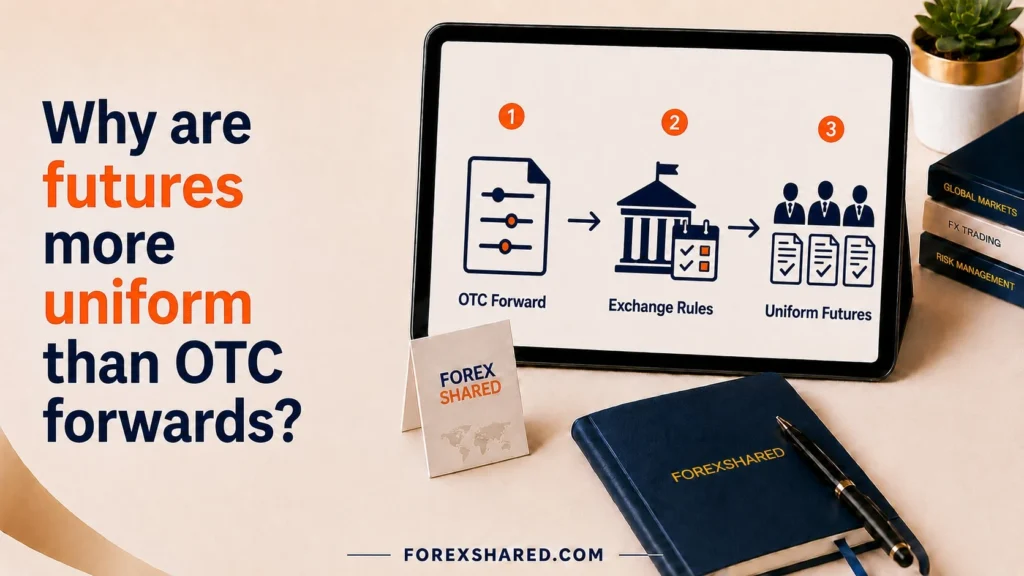
Why are futures more uniform than OTC forwards?
Futures are more uniform than OTC forwards because every position in the same listed product and expiry is governed by one exchange-published contract specification. The contract unit, quotation convention, minimum tick, expiry timetable and final settlement method are fixed for that contract class. An OTC forward, by contrast, is a bilateral agreement whose currencies, amounts, value date, rate and settlement structure can be agreed for the individual transaction within market, legal, credit and operational limits.
The parent standardisation mechanism is explained in Standardized futures contracts.
This article is for general education only and does not constitute financial, investment, trading, legal, accounting, regulatory or tax advice. Futures involve leverage, daily mark-to-market cash flows, margin calls and contract-specific expiry or delivery obligations. OTC forwards involve bilateral credit, collateral, settlement, documentation and liquidity risks that vary by counterparty, product and jurisdiction.
What does futures uniformity actually mean?
Uniformity means the legal and economic template is the same for every participant using the same product and expiry. CFTC materials describe exchanges as setting standard terms such as contract size, delivery months, last trading day and delivery conditions, while the CFTC glossary connects standardised material terms with fungibility. CFTC2026 CFTC2026
Which elements are common across traders?
For the same product and expiry, traders share the same underlying or currency pair, contract unit, quotation method, minimum price fluctuation, listed expiry, last-trade rules and final settlement process. Exchange and clearing rulebooks also provide the common operational framework used to trade, clear and settle the contract.
Which elements still differ between traders?
Position direction, whole-contract quantity, execution price, entry time, exit time, account structure and trading purpose can differ. Uniformity does not mean every trader pays the same price or receives the same profit and loss; it means they trade the same contractual building block.
Does standardisation guarantee liquidity?
No. Standardisation supports fungibility, transparent comparison and concentration of orders, but a listed contract can still be thinly traded. Actual liquidity depends on the product, expiry, market conditions, participant demand and available order-book depth.
Uniformity applies within one product and expiry. A standard, E-mini and Micro contract may reference the same currency pair, but each is a separate listed product with its own fixed unit, tick and product code.
| Layer | Fixed or common | Variable by trader |
|---|---|---|
| Product identity | Underlying, contract unit, quotation, tick, product code. | Choice of which listed product to trade. |
| Maturity | Listed contract months, last trading day and final settlement rules. | Choice of available expiry and whether to close, roll or settle. |
| Trading | Permitted quotation grid and venue rules. | Long or short direction, whole-contract quantity and execution timing. |
| Clearing | Common CCP rulebook, settlement-price methodology and default framework. | Actual margin depends on position, portfolio, account and intermediary treatment. |
Which official product specifications show futures uniformity?
The CME Euro FX product family provides a clear example. The 2026 CME FX product guide lists standard Euro FX futures at EUR 125,000, E-mini EUR/USD futures at EUR 62,500 and Micro EUR/USD futures at EUR 12,500. Each product also has its own code and minimum tick. CME2026
How do standard, E-mini and Micro products remain standardised?
Each variant is a separate listed product. Traders cannot purchase a fraction of one contract, but they can combine whole-contract positions across variants where those products are available. The combined exposure must be calculated from each product’s own unit.
| Product | Globex code | Contract unit | Quoted tick example | Product status |
|---|---|---|---|---|
| Standard Euro FX | 6E | EUR 125,000 | 0.00005 USD per EUR = USD 6.25 | Separate standard product |
| E-mini EUR/USD | E7 | EUR 62,500 | 0.0001 USD per EUR = USD 6.25 | Separate half-size product |
| Micro EUR/USD | M6E | EUR 12,500 | 0.0001 USD per EUR = USD 1.25 | Separate one-tenth-size product |
How is total currency exposure calculated?
For one product, the underlying currency exposure equals the whole-contract quantity multiplied by that product’s contract unit. A mixed portfolio is calculated line by line. For example, one standard 6E contract plus two M6E contracts represents EUR 125,000 + EUR 25,000 = EUR 150,000 of gross long euro exposure before considering any offsetting positions.
What makes OTC forwards less uniform?
OTC forwards are less uniform because the transaction economics are agreed bilaterally rather than selected from one listed contract class. BIS defines an outright forward as a contract to exchange two currencies at a rate agreed on the contract date for future value, delivery or cash settlement, and BIS reporting guidance notes that forward terms are generally not standardised. BIS2026
The practical expression of this structure is covered in Bespoke forward contracts.
Which terms can differ by transaction?
The parties may agree the currency principals, buy and sell direction, value date, outright rate or forward points, deliverable or non-deliverable treatment and settlement instructions. Availability remains subject to market liquidity, dealer capability, legal documentation, credit approval and applicable regulation.
Are all legal terms renegotiated for every trade?
No. Many counterparties use standard master agreements, credit-support documents, standing settlement instructions and market conventions. The individual confirmation then records the transaction-specific economics. The forward is therefore less uniform than a listed futures class without being informal or legally vague.
Can two similar forwards still be separate legal obligations?
Yes. Two trades may have the same currencies, amount and value date yet remain separate contracts. An opposite transaction can reduce net market exposure, but it does not automatically extinguish the first trade. Termination, amendment or novation must follow the governing documentation. ISDA2011
How does central clearing change the processing framework?
Exchange standardisation creates the contract class; central clearing then provides a common risk and settlement framework. CME Clearing states that it becomes the legal counterparty to every buyer and seller of a trade it accepts for clearing, collects performance-bond collateral and marks positions to market at least once each business day. CME2023
The difference in counterparty-risk handling is examined further in OTC versus exchange-cleared exposure.
Is the daily settlement price common to all positions?
Yes. The exchange publishes an official daily settlement price under a disclosed methodology, and open positions in that contract are marked to market against that reference. However, each account’s cash flow differs with its previous settlement level, direction and number of contracts. CME2026
Are margin amounts identical for all traders?
No. A common methodology and rulebook do not produce one universal amount. Margin can vary with position size, portfolio offsets, concentration, volatility, clearing-member treatment, account type and broker add-ons. The CCP sets clearing-level requirements, while an FCM may require more from a customer.
Does clearing eliminate counterparty risk?
No. Clearing changes and mitigates the risk structure through novation, margin, netting and default resources. Users can still face their broker or clearing member, the CCP, settlement infrastructure and liquidity demands from margin calls.
A futures contract specification fixes the product unit, tick and expiry. Margin is a dynamic risk-control requirement calculated under the clearing and account framework; it is not a permanent economic term comparable to the contract unit.
How do futures and forwards differ in settlement and collateral?
The instruments must be compared across three separate layers: daily valuation, collateral or margin transfers, and final contractual settlement. Saying that futures “settle daily” while forwards “settle once” is incomplete because some OTC portfolios exchange variation margin before maturity.
| Aspect | Exchange-traded futures | Deliverable FX forward | Non-deliverable forward |
|---|---|---|---|
| Daily valuation | Official daily settlement price under the exchange methodology. | Valued by the counterparties under the agreement or collateral process. | Valued under the agreement before the fixing and settlement dates. |
| Interim cash flows | Variation settlement and margin through the clearing framework. | Collateral or variation margin may apply depending on regulation and documentation. | Collateral or variation margin may apply depending on regulation and documentation. |
| Final contractual settlement | Cash settlement or delivery under the listed contract timetable. | Exchange of the two currency principals under the agreed value-date terms. | Cash-difference settlement using the agreed fixing and settlement currency. |
| Counterparty structure | CCP becomes legal counterparty after acceptance for clearing. | Bilateral obligations, potentially supported by collateral and netting. | Bilateral obligations, potentially supported by collateral and netting. |
| Early economic offset | Opposite transaction in the same product and expiry reduces the cleared net position. | Opposite trade can offset exposure but may leave both legal contracts outstanding. | Opposite trade can offset exposure but may leave both legal contracts outstanding. |
BCBS-IOSCO margin standards exclude physically settled FX forwards and swaps from the general initial-margin scope but recognise variation margining as a common and established practice among significant participants, with implementation depending on supervisory guidance or national regulation. BCBS2020
Why does standardisation make futures fungible?
Fungibility means contracts within the same listed class are interchangeable for trading and clearing purposes. A trader does not need the original counterparty to reduce a position; an opposite transaction in the same product and expiry changes the participant’s cleared net position under the exchange and CCP rules.
Does fungibility create an unrestricted transfer right?
No. Give-ups, account transfers, position transfers and portability are governed by exchange, clearing-member, FCM and customer-account procedures. Standardisation makes the contract class compatible, but operational transfer still requires the applicable process.
Is the OTC market completely non-standard?
No. OTC forwards often use common currency conventions, standard tenors, standard master agreements and standard confirmation formats. They remain less uniform because there is no single listed contract class that automatically replaces the transaction-specific bilateral obligations.
Futures offset is a cleared-position process inside one fungible contract class. Forward offset is an economic relationship between separate bilateral trades unless the parties complete a documented termination, amendment or novation.
When is each structure more practical?
Futures are usually more practical when the exposure aligns sufficiently with a listed unit and expiry, transparent order-book pricing is valuable, and the organisation can support daily margin cash flows. Forwards are often more practical when the amount, value date or settlement structure needs a closer fit to a specific commercial obligation.
| Decision factor | Futures may fit better when | OTC forward may fit better when |
|---|---|---|
| Amount | The exposure aligns closely with available whole-contract units. | The exposure requires a transaction-specific notional. |
| Date | A listed expiry provides an acceptable hedge horizon. | A specific eligible value date is required. |
| Liquidity and exit | An active listed contract and ease of offset are priorities. | The user accepts bilateral amendment or termination processes. |
| Cash-flow capacity | The organisation can meet daily variation-margin and collateral demands. | The organisation prefers maturity-based currency exchange, subject to any bilateral collateral obligations. |
| Counterparty framework | CCP clearing and the associated intermediary chain are appropriate. | A bilateral credit, collateral and netting relationship is appropriate. |
How should the comparison be validated?
- Product identity: confirm the exact futures code, contract unit, expiry and settlement method.
- Whole-contract sizing: calculate standard, E-mini and Micro products separately before combining exposure.
- Forward economics: confirm currencies, amounts, quote orientation, rate, value date and deliverable or NDF treatment.
- Daily cash flow: distinguish futures variation settlement from final settlement and from bilateral collateral transfers.
- Margin source: separate CCP requirements from FCM or broker customer add-ons.
- Legal offset: do not treat a second forward as automatic cancellation of the first.
- Liquidity: verify the actual listed expiry or dealer market rather than assuming all futures are liquid or all forwards are illiquid.
- Counterparty chain: identify the exchange, CCP, clearing member, FCM and bilateral counterparty exposures that remain.
- Settlement deadline: confirm the last trading day, final settlement date, fixing date and operational cut-offs as applicable.
- Commercial fit: choose the structure based on amount, date, liquidity, funding and governance requirements.
Conclusion
Futures are more uniform than OTC forwards because the exchange creates one contract class whose material product terms apply to every position in the same product and expiry. That standardisation supports fungibility, centralised price discovery and a common clearing process. Traders can change direction and whole-contract quantity, but they cannot rewrite the contract unit, tick, expiry or final settlement method for one position.
OTC forwards use a different architecture. The transaction economics can be aligned more closely with a particular currency obligation, while master agreements, collateral terms and settlement instructions govern the wider bilateral relationship. This precision does not make the contract informal, and an opposite trade does not automatically terminate the original legal obligation.
The practical choice is therefore not uniformity versus quality. It is a choice between a fungible listed product with daily clearing cash flows and a less fungible bilateral instrument with transaction-specific economics. The correct structure depends on the exposure amount, value date, available liquidity, margin capacity, settlement needs and counterparty framework.
Frequently Asked Questions
Does futures uniformity mean every trader receives the same price?
No. Traders share the same product specification, quotation convention, tick, expiry and settlement rules, but transaction prices depend on the orders available when each trade is executed. The exchange also publishes an official daily settlement price used for mark-to-market processing.
Can standard, E-mini and Micro FX futures be combined?
Yes. They are separate listed products and each position must use whole contracts, but a portfolio can combine standard, E-mini and Micro contracts where the products are available. The combined exposure must be calculated from each product’s own fixed contract unit.
Do OTC forwards always wait until maturity before any cash moves?
No. The contracted currency delivery or cash-difference settlement occurs under the maturity terms, but collateral or variation-margin transfers may occur before maturity when required by the agreement, regulation or counterparty framework.
Does an opposite OTC forward cancel the original contract?
Not automatically. An opposite trade can reduce the net market exposure, but both transactions may remain separate legal obligations unless the original trade is terminated, amended, novated or otherwise extinguished under the governing documentation.
Are futures margin amounts identical for every trader?
No. Futures positions are governed by a common clearing and settlement framework, but actual margin amounts can vary with position size, portfolio offsets, volatility, concentration, account type, clearing-member treatment and additional broker requirements.