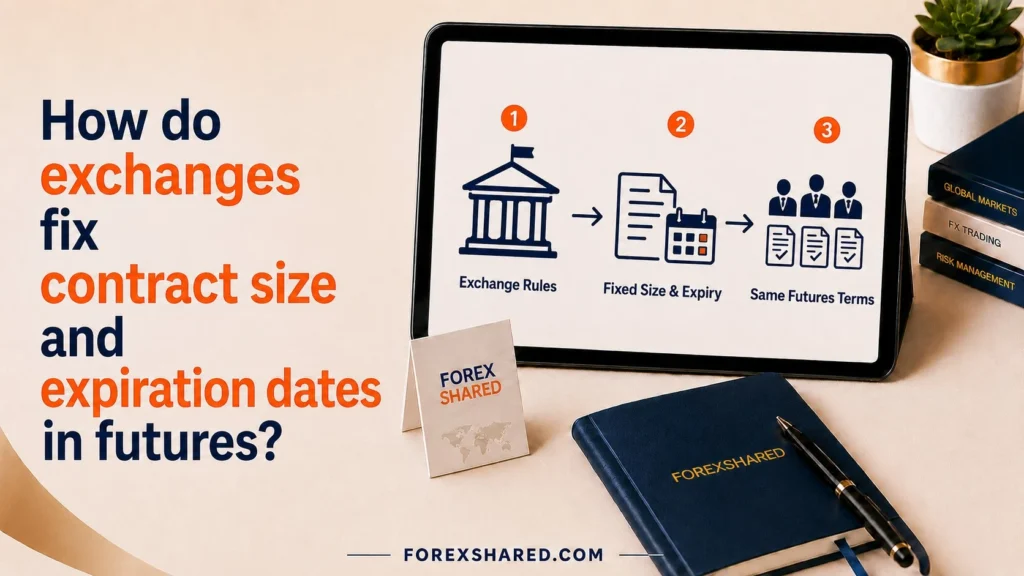
How do exchanges fix contract size and expiration dates in futures?
Exchanges fix contract size and expiration dates by defining them in the product’s published rules and contract specification before trading begins. The fixed unit, listed contract months, last trading day and final settlement process then apply to every position in that product and expiry, while buyers and sellers determine the market price through trading. The terms can later change only through the exchange’s formal rule and notice process, not through negotiation by one trader.
The parent concept is explained in Standardized futures contracts.
This article is for general education only and does not constitute financial, investment, trading, legal, accounting, regulatory or tax advice. Futures are leveraged instruments subject to performance-bond margin, daily mark-to-market cash flows, margin calls, broker or clearing-member requirements, and contract-specific expiry, delivery or cash-settlement procedures.
What does it mean for an exchange to fix contract terms?
Exchange-fixed terms are the product attributes that a trader accepts by choosing a listed futures contract. The exchange publishes the unit, quotation, tick, listed months, trading deadlines and final settlement rules; it does not set the continuously changing futures price.
CFTC educational material identifies contract size, delivery months, last trading day and related terms as standardised features established for a futures contract, while market participants compete at different prices within that common structure. CFTC2026
Which product attributes are fixed?
The exact fields vary by product, but an FX futures specification normally identifies the underlying currency exposure, contract unit, quotation convention, minimum price fluctuation, listed contract months, termination of trading and final delivery or cash-settlement process. Clearing, margin and trading rules also apply, although they may appear in separate rulebook chapters or clearing documentation.
| Specification | What the exchange publishes | What the trader can choose |
|---|---|---|
| Underlying and quotation | The currency represented by the contract and the units in which price is quoted. | Whether to take a long or short position at an available market price. |
| Contract unit | The fixed quantity represented by one contract. | The number of whole contracts and any separately listed product variant. |
| Minimum price fluctuation | The smallest permitted price increment and its contract-level monetary effect. | The limit or market price used for an order, subject to the tick grid. |
| Listed months | The contract-month schedule available for trading. | Which available month to trade. |
| Trading deadline | The last trading day and termination time for each series. | Whether to close, roll or remain open subject to the settlement process. |
| Final settlement | The physical-delivery or cash-settlement terms, dates and procedures. | Operational instructions permitted under the rules and clearing arrangements. |
Does standardisation guarantee liquidity?
No. Uniform terms make contracts comparable and fungible within the same product and expiry, which can support liquidity concentration and transparent price discovery. Actual liquidity still depends on participation, market conditions, the product and the contract month.
The exchange fixes the contract template and price increments. It does not guarantee a particular market price, trading volume, spread, margin level or hedge result.
Who establishes, regulates and administers the fixed terms?
The exchange or designated contract market develops and publishes the product rules, the regulator supervises compliance and the product-listing process, and the clearinghouse determines how accepted trades are margined, novated and settled. These roles interact, but they should not be collapsed into a single institution.
| Institution | Primary role | What it does not do |
|---|---|---|
| Exchange or DCM | Lists the product, publishes the rulebook and contract specification, and sets trading rules and product terms. | Does not fix the competitive market price for each trade. |
| Regulator | Oversees compliance and receives a self-certification or reviews an approval request under the applicable regime. | Does not normally choose the commercial contract unit for the exchange. |
| Clearinghouse | Accepts eligible trades for clearing, becomes central counterparty, collects margin and administers settlement and default management. | Does not replace the exchange’s published product specification with trader-specific terms. |
| Broker or FCM | Provides account access, applies customer controls and margin requirements, and interfaces with clearing arrangements. | Cannot privately change the listed unit, expiry or settlement method for one customer. |
How does the U.S. product-listing process work?
A U.S. DCM can generally list a product by filing a self-certification that the contract complies with the Commodity Exchange Act and CFTC regulations, or it can request Commission review and approval. Self-certification is made by the DCM; it is not a certification issued by the regulator. CFTC2026
What happens after a trade is executed?
The exchange trading system matches compatible orders. For a trade accepted for clearing, the clearinghouse becomes the buyer to the seller and the seller to the buyer, then applies margin, settlement and default-management processes. CME2026
How does the exchange fix the contract unit?
The exchange fixes the unit by selecting and publishing one quantity for each listed product. There is no universal equation that determines the size of every futures contract; the binding unit is the quantity stated in the current product rules, and any rationale or later change must be read from the relevant filing and exchange notice.
Why are named product examples essential?
FX futures do not share one universal “standard” size. CME’s standard Euro FX future represents EUR 125,000, while Micro EUR/USD represents EUR 12,500, one-tenth of that standard product. Other currency products use different units. CME2026 CME2026
| Product example | Contract unit | Minimum price fluctuation | Contract-level tick value |
|---|---|---|---|
| Standard Euro FX | EUR 125,000 | USD 0.00005 per EUR on CME Globex | USD 6.25 |
| Micro EUR/USD | EUR 12,500 | USD 0.0001 per EUR | USD 1.25 |
Can a trader use fractional contracts?
No. Listed futures positions use whole-contract quantities. A trader seeking a finer exposure can use a separately listed Micro product where available or combine whole positions across distinct standard and Micro contracts. The products remain separate even when their currency exposures are managed together.
What is the difference between contract unit and quote-currency equivalent?
The underlying currency unit is fixed. Its current quote-currency equivalent changes with the futures price. For a EUR 125,000 contract quoted at USD 1.2000 per EUR, the quote-currency equivalent is USD 150,000:
EUR 125,000 × USD 1.2000 per EUR = USD 150,000
This calculation does not mean that the fixed euro principal changed, and it should not be confused with the contract’s current profit, loss or margin requirement.
How does the exchange fix expiration and settlement dates?
The exchange publishes the listed contract months and the precise rules for termination of trading and final settlement. The contract month is a series identifier, not the exact last trading day, and the same currency may have monthly, quarterly or other product-specific listing schedules.
Why are expiry schedules product-specific?
CME’s FX suite includes products with monthly and quarterly expiries, while other products use narrower schedules. The official specification—not a generic assumption about March, June, September and December—determines which months are available. CME2026
How do contract month, last trading day and final settlement differ?
The contract month names the listed series. The last trading day is the exact date and time at which trading terminates. Final delivery or cash settlement follows the product’s rules and can occur on a different date. A trader must verify all three rather than treating the month label as the deadline.
What is the CME physically delivered FX convention?
For many physically delivered CME FX futures, the currency value date is the third Wednesday of the contract month and trading generally ends on the second business day immediately preceding that Wednesday. CME identifies exceptions, including Canadian dollar and cash-settled currency products, so the convention must not be applied universally. CME2026
How are the fixed terms formalised and changed?
The exchange formalises contract terms through its rulebook, product specification, listing materials and applicable regulatory filings. These sources should be read together because a concise product page may not reproduce every legal, trading, clearing or delivery rule.
Which source is authoritative?
The current exchange rules and official product documentation govern the listed contract, subject to applicable law and regulatory requirements. Marketing summaries can help navigation but should not override the rulebook, clearing rules or formal exchange notices.
Can the exchange amend a contract after listing?
Yes. A DCM can amend product terms through the applicable exchange-governance and regulatory-filing process. Whether a change affects existing positions depends on its effective date, the contract months covered and any transition provisions stated in the filing or exchange notice. It is therefore inaccurate to assume that every amendment automatically rewrites every open position.
Why does the full format matter to participation?
Contract size and expiry do not operate alone. The quotation, tick, trading hours, position rules, settlement method, margin framework and notices determine how the product can be traded and managed. The complete participation framework is covered in Futures contract format.
How do traders adapt to fixed contract size and expiry?
Traders adapt by choosing among available product variants and contract months, using whole-contract quantities, managing margin and deciding whether to close, roll or participate in final settlement. These decisions occur inside the fixed exchange template.
When is a roll used?
A roll is used when a trader wants to maintain similar market exposure beyond the current contract’s expiry. The trader closes or reduces the near contract and opens a later month. The deferred contract can trade at a different price, so a roll is a new pair of transactions rather than an extension that preserves the original entry price.
What does futures margin represent?
Futures margin is a performance bond, not a down payment on the underlying currencies. Positions are marked to market, adverse moves can reduce the available balance and additional funds may be required. Clearing-level requirements and customer requirements are separate layers; a broker or FCM can require more than the clearing minimum. CME2026
What happens if a position remains open at expiry?
The position follows the product’s final settlement procedures through the clearing member. Depending on the contract, this can involve physical currency delivery or cash settlement. A trader that does not intend to participate must act before the applicable trading and broker deadlines rather than relying on the contract-month label.
Why are fixed futures terms different from OTC forward terms?
Futures use exchange-published units and listed expiries so that contracts in the same product and month are fungible and centrally cleared. OTC forwards are generally negotiated bilaterally and their contractual terms are not standardised, although market conventions and dealer capacity still constrain what can be agreed. BIS2026
The instrument-level comparison is explained in Futures versus OTC forwards.
| Attribute | Exchange-listed FX future | OTC forward |
|---|---|---|
| Contract unit | Fixed by the listed product; whole contracts are traded. | Mutually agreed within market, credit, legal and operational limits. |
| Maturity | Chosen from listed contract months and product-specific deadlines. | Mutually agreed eligible value date or settlement structure. |
| Price formation | Market price forms through exchange trading within the published tick grid. | Dealer or platform quote reflects the negotiated OTC transaction. |
| Counterparty framework | Clearinghouse interposition, margin and default-management arrangements mitigate counterparty credit risk. | Bilateral exposure can be managed through credit limits, collateral and enforceable netting. |
| Offset or exit | An opposite trade in the same product and month can close the position through the clearing system. | An opposite transaction can offset market exposure, but the original contract may remain legally outstanding unless terminated or novated. |
| Hedge fit | Depends on how closely the listed unit and expiry match the commercial exposure. | Can be shaped more closely around a specific amount and date, subject to availability and pricing. |
What limitations remain after the exchange fixes the terms?
Standardisation solves product compatibility; it does not remove market, liquidity, margin, basis, operational or settlement risk. A listed product can still be illiquid, the fixed unit can create a hedge mismatch, margin can change, and an expiry can differ from the commercial cash-flow date.
Can a fixed unit create under-hedging or over-hedging?
Yes. An exposure that is not an exact multiple of an available unit leaves a residual or requires additional contracts. Standard and Micro products can reduce the increment where both are available, but they do not guarantee an exact match for every amount.
Does central clearing eliminate counterparty risk?
No. It changes and mitigates the risk through central-counterparty interposition, margin and default resources. Clearing-member, broker, CCP, liquidity and operational risks can remain, and adverse market moves can create immediate cash demands.
Can a published margin level remain fixed?
No. Performance-bond requirements can change with product risk and market volatility, and customer requirements can differ from clearing minimums. Contract size and expiry can remain fixed while the amount of collateral needed to support the position changes.
Exchange-fixed terms make the product uniform. They do not guarantee liquidity, a perfect hedge, stable margin, successful settlement or a favourable trading result.
How should exchange-fixed contract terms be validated?
A trader or hedger should validate the official specification, the chosen contract month and the account’s operational requirements before placing an order. Product terms can differ even when two contracts reference the same currency.
- Product identity: confirm the exchange, product code, underlying currency and quotation convention.
- Contract unit: verify the fixed currency quantity and whether a smaller listed variant exists.
- Tick: identify the minimum price fluctuation and contract-level monetary value.
- Contract month: confirm that the selected series is actually listed and liquid enough for the intended use.
- Last trading day: record the exact date and time when trading terminates.
- Final settlement: determine whether the position is physically delivered or cash-settled and through which clearing process.
- Margin: distinguish clearing performance-bond requirements from the broker or FCM’s customer requirement.
- Roll plan: decide whether the position will close, roll or remain open for final settlement.
- Notices: review current exchange circulars for changes, effective dates and affected contract months.
- Hedge fit: calculate any quantity or timing mismatch between the listed contract and the commercial exposure.
Conclusion
Exchanges fix contract size and expiration dates by publishing one binding product specification for each listed futures contract. The contract unit defines the quantity represented by one whole contract, while the listing schedule, last trading day and final settlement rules define the life of each contract month. Traders choose among the available products, months and quantities, but they do not negotiate a private unit or expiry inside the listed contract.
The fixed structure supports fungibility, central clearing and comparable price discovery, but it does not guarantee liquidity, a perfect hedge or stable margin. Product units and expiry conventions are specific rather than universal, regulatory filings and exchange notices can change terms prospectively, and the full rulebook must be read before a trader decides to close, roll or participate in settlement.
Frequently Asked Questions
Can a trader negotiate a different contract unit or expiry date?
No. A trader must use the contract unit, listed month and settlement rules published for that futures product. A smaller exposure requires a separately listed product, such as a Micro contract where available, or a combination of whole contracts; it does not change the standard contract itself.
How does an exchange decide the contract size?
There is no universal formula. The exchange designs and publishes a unit that it considers workable for the product, market and intended users, while also addressing clearing, settlement and regulatory requirements. The binding answer for any product is the current rulebook, contract specification and applicable exchange notices.
Is the contract month the same as the last trading day?
No. The contract month identifies the listed series, while the last trading day is a precise calendar deadline set by the product rules. Final delivery or cash settlement can occur on a different date, so traders must verify all three items separately.
Can standard and Micro FX futures be combined?
Yes. A trader can hold separate whole-contract positions in standard and Micro products where both are listed. For example, standard Euro FX and Micro EUR/USD contracts can be combined to refine total euro exposure, but they remain distinct products with separate codes, order books and specifications.
Does central clearing remove every risk from an FX futures position?
No. Central clearing, novation, margining and default-management arrangements mitigate counterparty credit risk, but market, liquidity, margin, operational, broker, clearing-member and settlement risks can remain. A trader can also be required to provide additional funds when the position moves adversely.