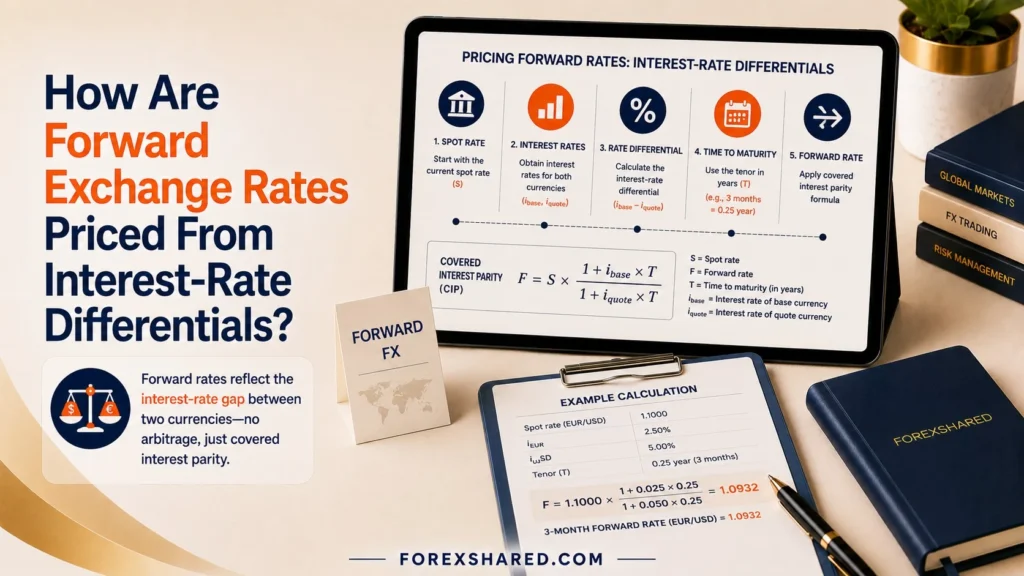
How Are Forward Exchange Rates Priced From Interest-Rate Differentials?
An FX forward rate starts with the current spot rate and adjusts it for the relative funding and discounting conditions of the two currencies over the exact contract tenor. Under simplified covered-interest-parity assumptions, the adjustment prevents two fully hedged currency-investment routes from producing different terminal values.
An executable dealer rate is more complex than the textbook formula. It can also reflect the quotation convention, currency-specific day counts, collateral terms, cross-currency basis, liquidity, credit, balance-sheet costs and bid-ask spreads.
For the parent explanation of outright forwards, rate formation and settlement obligations, see Forward forex pricing mechanics.
This article is for general education only and does not constitute financial, investment, trading, legal, operational or tax advice. Forward pricing, curve construction, collateral treatment, spreads and contractual terms vary by currency pair, counterparty, agreement, settlement method and market conditions.
- Spot is the starting rate: the quotation convention defines which currency is base and which is quote.
- Two curves matter: pricing compares maturity-matched growth or discount factors for both currencies.
- CIP is a benchmark: persistent basis deviations can exist when arbitrage is costly or constrained.
- Forward points are rate increments: they are not interest-rate basis points.
- The forward is not a forecast: it is a contracted hedged price derived from current inputs.
What Is the Core Relationship Between Spot, Currency Curves and Maturity?
The spot rate supplies the current conversion ratio. The two maturity-specific currency curves determine how one unit of each currency grows or discounts between the spot value date and the forward value date. The exact tenor determines the relevant accrual period.
Before applying any formula, define the quotation. In a pair written as GBP/USD, GBP is the base currency and USD is the quote currency, so a price of 1.2500 means GBP 1 equals USD 1.2500. CME2026
What Is the Simple-Compounding Formula?
For a quotation expressed as units of quote currency per unit of base currency, the simplified forward formula is:
Here, S is spot, rQ and rB are maturity-matched quote- and base-currency rates, and αQ and αB are the applicable accrual fractions.
Why Is the Quote-Currency Growth Factor in the Numerator?
Starting with one base unit, spot converts it into S quote units. The quote amount grows at the quote-currency return, while the base unit grows at the base-currency return. The forward rate must equalise the two terminal outcomes.
What Is the Discount-Factor Formula?
This form is structurally more general because each discount factor can come from a full maturity-specific curve. Substituting simple-interest discount factors reproduces the growth-factor formula.
What Is Covered Interest Parity?
Covered interest parity is the benchmark relationship that equates the terminal value of two otherwise comparable, fully hedged currency-investment routes. Under simplified no-arbitrage assumptions, the interest-rate differential should be consistent with the forward–spot differential.
CIP is not a claim that every observable forward exactly equals a frictionless formula. BIS research documents persistent cross-currency-basis deviations associated with hedging demand, balance-sheet costs and limits to arbitrage. BIS2016 BIS2024
Why Is the Exposure Called Covered?
The participant uses a forward to lock the future conversion rate. This removes the open exchange-rate uncertainty of the covered cash flow, subject to counterparty performance, settlement and the governing contract.
How Does CIP Differ From Uncovered Interest Parity?
| Feature | Covered Interest Parity | Uncovered Interest Parity |
|---|---|---|
| Forward hedge | Uses a forward or equivalent hedge. | Leaves future FX conversion unhedged. |
| Core role | No-arbitrage pricing benchmark under stated assumptions. | Expectation relationship involving future spot movements. |
| Main observable | Current spot, forward and maturity-matched market curves. | Expected future spot rate, which is not directly observable. |
| Market deviations | Persistent basis deviations can occur when arbitrage is costly or constrained. | Not an executable hedged pricing identity. |
How Does Cash-and-Carry Replication Produce the Formula?
Assume the exchange rate is quoted as quote currency per base currency and begin with one unit of quote currency.
- Route one: invest the quote currency to obtain
1 + rQαQquote units at maturity. - Route two: convert one quote unit into
1/Sbase units at spot. - Invest the base amount to obtain
(1 + rBαB)/Sbase units. - Sell those base proceeds forward at
F, producingF(1 + rBαB)/Squote units.
Equating the two terminal amounts and rearranging produces the simple CIP formula.
What If the Market Forward Is Above the Frictionless Benchmark?
In the simplified model, the participant would choose the cheaper funding route and take the opposite forward position. In real markets, transaction costs, credit limits, regulatory capital, balance-sheet capacity and market access can prevent the apparent gap from being freely arbitraged.
Which Currency Trades at a Forward Premium or Discount?
The detailed directional logic is covered in Forward premium and discount. Under textbook CIP using comparable effective funding rates, the higher-yielding currency trades at a forward discount against the lower-yielding currency.
What Happens When the Quote-Currency Rate Is Higher?
For a quote-per-base exchange rate, the numerator grows faster, so the theoretical forward sits above spot. The base currency is at a forward premium and the quote currency is at a forward discount.
What Happens When the Base-Currency Rate Is Higher?
The denominator grows faster, so the theoretical forward sits below spot. The base currency is at a forward discount.
What Are Forward Points?
Forward points are the exchange-rate increments added to or subtracted from spot to produce the all-in forward rate for a specified value date. The shared pricing logic between outright forwards and FX swaps is examined in Swap points and pricing.
How Are Points Calculated?
The market display then scales that difference according to the pair’s quotation convention. For a four-decimal display in which one quoted point is 0.0001, a difference of 0.0061 is approximately +61 points.
Are FX Points the Same as Interest-Rate Basis Points?
No. One interest-rate basis point equals 0.01 percentage points. An FX point is a pair-specific exchange-rate increment. They are different units even though interest-rate conditions influence the forward-point curve.
What Is the First-Order Approximation?
This approximation provides intuition for modest rates and short tenors. It omits separate day counts, compounding, curve shape, basis and execution spreads, so it should not replace date-specific market pricing.
Which Rates and Curves Should Professional Pricing Use?
Professional pricing uses maturity-specific market curves, observable forward points or both. A central-bank policy rate is not automatically the correct funding input for a six-month forward.
How Do Overnight Benchmarks Fit Into the Curves?
SOFR, SONIA and €STR are overnight benchmarks. Compounded averages, indexes and traded instruments can help construct term discount curves, but a raw overnight fixing is not itself the six-month rate. The New York Fed publishes compounded SOFR averages and an index; the Bank of England defines SONIA using one-business-day unsecured transactions; and the ECB defines €STR as an overnight wholesale unsecured borrowing rate and publishes compounded averages. NYFed2026 BoE2026 ECB2025
Why Can Day-Count Fractions Differ?
The relevant benchmark, instrument and contract define the accrual convention. The two currency legs can therefore use different fractions even over the same calendar interval.
| Benchmark | Underlying Rate | Common Compounding Day Count | Pricing Lesson |
|---|---|---|---|
| SOFR | Secured overnight US-dollar financing rate. | Actual/360 for published averages. | Use the relevant compounded or curve-derived maturity input, not one daily fixing. |
| SONIA | Unsecured sterling transactions of one-business-day maturity. | Compounded sterling conventions commonly use Actual/365 Fixed. | The exact product documentation controls the accrual calculation. |
| €STR | Wholesale unsecured euro overnight borrowing rate. | Euro overnight-index conventions commonly use Actual/360. | ECB compounded averages and index cover standard and custom periods. |
How Do Collateral Terms Affect Pricing?
Collateral currency, eligible collateral and remuneration terms can influence discounting. OIS-based discounting is common for cash-collateralised derivatives, but the correct treatment depends on the actual credit-support agreement. ISDA’s Standard Credit Support Annex was designed in part to promote OIS discounting and align collateral mechanics. ISDA2013
An uncollateralised trade should not be reduced to one universal “unsecured curve.” Credit, funding and valuation adjustments can also be relevant.
How Do Cross-Currency Basis and Bid-Ask Spreads Change the Quote?
Cross-currency basis is the wedge observed when synthetic funding through the FX swap or forward market differs from direct cash-market funding after comparable rates are considered. BIS research links persistent basis to hedging demand and the cost of committing bank balance sheets to arbitrage. BIS2016
Is Every Basis Deviation a Free Arbitrage?
No. A calculated gap may lie inside a neutral band created by transaction costs, market access, credit limits, capital usage, balance-sheet costs and execution risk. The relevant comparison is an executable, scalable strategy—not an unconstrained mid-rate calculation.
How Does the Dealer Spread Enter the Rate?
Dealers quote bid and ask spot rates and bid and ask forward points. The all-in forward bid and ask therefore incorporate both components. The spread varies by pair, size, tenor, liquidity, credit and market conditions; it does not necessarily widen smoothly with every additional day of maturity.
What Numerical Example Shows the Formula?
Assume GBP/USD is quoted as USD per GBP, spot is 1.2500, the illustrative six-month USD rate is 5.00%, the illustrative six-month GBP rate is 4.00%, and both simplified accrual fractions are 0.5.
- Quote-currency growth factor:
1 + 0.05 × 0.5 = 1.025. - Base-currency growth factor:
1 + 0.04 × 0.5 = 1.020. - Growth-factor ratio:
1.025 / 1.020 ≈ 1.004902. - Forward rate:
1.2500 × 1.004902 ≈ 1.2561. - Rate difference:
1.2561 − 1.2500 = 0.0061, approximately +61 points under a four-decimal display.
How Should a Forward Rate Be Interpreted?
- Define the quotation: identify base and quote currencies.
- Confirm the dates: use the actual spot and forward value dates.
- Select the curves: use maturity-specific market inputs consistent with the contract and collateral terms.
- Calculate the benchmark: apply growth factors, discount factors or observable forward points.
- Read the direction: determine the theoretical premium or discount under the stated quote.
- Apply market adjustments: account for basis, liquidity, credit, balance-sheet costs and bid-ask spread.
- Keep price and forecast separate: the contracted rate does not guarantee the future spot rate.
Which Common Mistakes Cause Pricing Errors?
- Applying a formula before defining the quotation convention.
- Using central-bank policy rates as direct substitutes for maturity-specific market curves.
- Using one accrual fraction when the two curve conventions differ.
- Confusing FX points with interest-rate basis points.
- Treating the first-order approximation as an executable valuation method.
- Ignoring cross-currency basis, collateral or bid-ask sides.
- Calling the forward rate a guaranteed forecast of future spot.
Conclusion
Forward exchange rates are priced by connecting spot with the relative maturity-specific funding or discount factors of two currencies. Covered interest parity supplies the core benchmark and cash-and-carry replication explains its logic.
The benchmark is only the beginning of an executable quote. Accurate pricing must respect the quotation convention, exact value dates, separate day-count rules, curve construction, collateral terms, cross-currency basis, liquidity, credit and dealer spreads.
A forward rate is therefore best understood as a current hedged contract price. It is not a promise that the future spot market will trade at the same level.
Frequently Asked Questions
What is covered interest parity in simple terms?
Covered interest parity is the benchmark relationship that equates a hedged investment in one currency with a hedged investment in another currency. Under simplified no-arbitrage assumptions, the spot rate, forward rate and two maturity-matched funding returns must be consistent.
Why does the forward rate differ from the spot rate?
The forward rate differs from spot because the two currencies have different funding and discounting conditions over the contract tenor. The quoted rate can also reflect cross-currency basis, collateral terms, liquidity and bid-ask spreads.
Which interest rates should be used for forward pricing?
Professional pricing uses maturity-specific market curves or observable forward points, not simply two central-bank policy rates. Overnight benchmarks can underpin those curves, but the raw overnight fixing is not itself a six-month or one-year funding rate.
Is the forward rate a forecast of the future spot rate?
No. The forward rate is a contracted hedged exchange rate derived from current market inputs. It is not a guarantee or direct forecast of the spot rate that will prevail at maturity.
What is cross-currency basis?
Cross-currency basis is the adjustment observed when funding one currency through the FX swap or forward market differs from direct cash-market funding after comparable rates are considered. It reflects market demand, balance-sheet costs and limits to arbitrage.