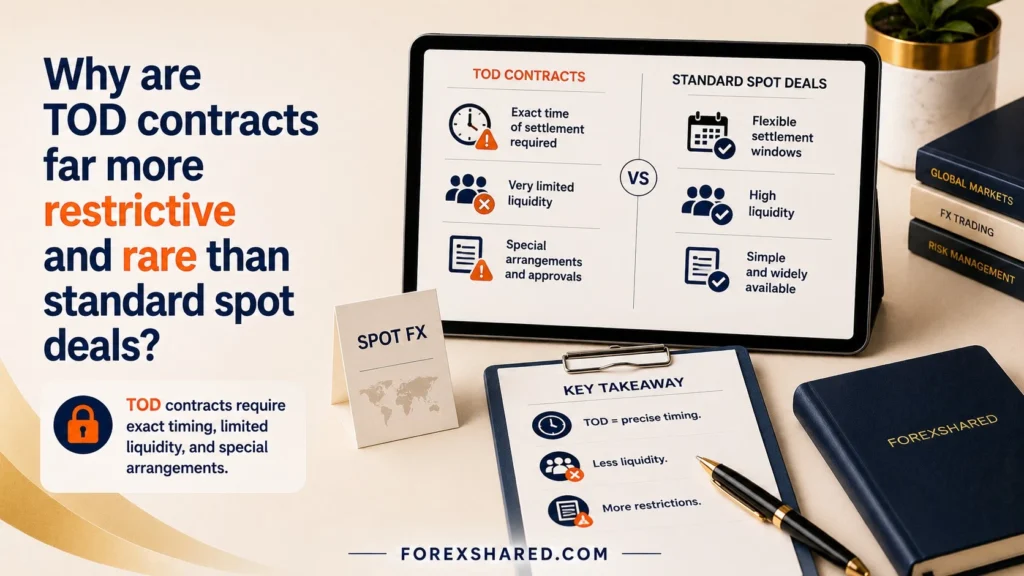
Why Are TOD Contracts Far More Restrictive and Rare Than Standard Spot Deals?
A TOD, value-today, or T+0 FX trade is intended to settle on the same valid business day on which the exchange rate is agreed. The word “contract” is common market shorthand, but TOD primarily identifies the selected value date rather than a separate universal FX product category.
The same-day value date compresses the time available to confirm the trade, validate settlement instructions, arrange funding, complete controls, submit payments, and manage exceptions. Standard-value spot normally leaves more operational time between execution and settlement, so it is generally easier to process.
For the parent framework covering non-standard value dates, holidays, and operational deviations, see Spot settlement exceptions.
This article is for general education only and does not constitute financial, investment, trading, legal, operational, or tax advice. Value-date eligibility, cut-offs, funding, credit approval, payment routes, netting, and settlement protections vary by currency, provider, counterparty, infrastructure, and jurisdiction.
- TOD is a value-date instruction: it targets settlement on the trade date.
- It can still fall within spot: outright FX settling within two business days is commonly classified as spot.
- Availability is conditional: calendars, cut-offs, funding, credit, payment routes, and instructions all matter.
- Netting is not automatically lost: eligible same-day trades may still be matched and netted within applicable service deadlines.
- Speed does not eliminate principal risk: the settlement method remains decisive.
What Does TOD Mean in Foreign Exchange?
TOD commonly means value today: the intended value date is the same business day as the trade date. Other labels can include cash value or T+0, and terminology may differ between institutions and markets.
Under the BIS statistical definition, an outright currency exchange settling in two business days or less is a spot transaction. TOD and TOM can therefore sit inside the broader spot category rather than being treated as unrelated market types. BIS Data Glossary, 2026
How Do TOD, TOM, and Standard Spot Differ?
TOD targets the trade date. TOM targets the next valid business day. Standard-value spot uses the normal value-date convention for the pair, commonly T+2 for many pairs and T+1 for USD/CAD. The correct value date also depends on holidays and valid business days for both currencies. New York Fed FX Survey Methodology, 2026
For the dedicated mechanical comparison, read TOD, TOM, and SPT differences.
Why Is Standard-Value Spot Operationally Easier?
A later value date creates more time for post-trade processing. The parties can confirm economics, validate standing settlement instructions, complete compliance checks, arrange funding, match obligations, and resolve exceptions before the payment deadline.
TOD compresses those activities into the remaining hours of the same business day. A process that is routine under a later value date may become conditional when there is insufficient time to repair a wrong account number, obtain credit approval, source a currency, or meet a correspondent cut-off.
Is TOD Universally Rare?
No public global dataset provides a definitive percentage split between T+0, T+1, and T+2 spot transactions. BIS turnover statistics group short-dated outright exchanges within spot rather than publishing a universal TOD share.
It is therefore more accurate to describe TOD as specialized and conditional than to assign it an unsupported global percentage. For market context, spot represented 31% of total global FX turnover in April 2025, while FX swaps represented 42%; those figures do not isolate TOD volume. BIS Triennial Survey, 2025
Why Do Cut-Off Times Restrict TOD Trading?
A TOD trade must be executed early enough for every required post-trade and payment step to finish on the same valid business day. The effective deadline is usually the earliest relevant operational cut-off, not the closing time of the broader FX trading session.
Relevant deadlines may include:
- The provider’s last time for accepting value-today instructions.
- Internal credit, compliance, and funding approval deadlines.
- Trade-confirmation and matching cut-offs.
- Deadlines for supplying or changing settlement instructions.
- Correspondent-bank and settlement-agent cut-offs.
- Domestic payment-system and PvP-service submission deadlines.
Why Can Trading Continue After TOD Closes?
Trading availability and same-day settlement availability are different. A dealer may continue quoting TOM, standard spot, forwards, or swaps after its value-today processing window has closed.
There is no single universal time at which every provider stops accepting TOD. Client deadlines can be earlier than external infrastructure deadlines because the provider needs time to complete internal processing and exception management.
How Do Time Zones and Payment Systems Limit Same-Day Settlement?
Each currency leg may use a different domestic payment system, correspondent account, settlement agent, or internal ledger. Different operating windows, holidays, cut-offs, and legal-finality rules can reduce the time available to complete both legs on the same value date.
The two domestic systems do not always need to be open at precisely the same instant. Institutions may use pre-positioned balances, intraday credit, correspondent accounts, netting arrangements, or specialized settlement services. The practical requirement is that the parties have an available payment route and enough operational overlap to complete both obligations by the relevant deadlines.
Which Current Infrastructure Names Matter?
Current examples include T2 for euro wholesale payments and the Fedwire Funds Service for eligible US-dollar payments. T2 replaced TARGET2 in March 2023, so current descriptions should use T2 rather than TARGET2. ECB TARGET Annual Report, 2023
Infrastructure names alone do not determine TOD eligibility. The relevant provider must confirm the actual payment route, calendars, cut-offs, funding arrangements, and risk controls for the requested trade.
Why Does TOD Require Earlier Funding Readiness?
A same-day value date leaves less time to source the currency that must be delivered. The participant may need an available balance, intraday credit, a correspondent position, an internal transfer, money-market funding, an FX swap, or another approved facility shortly after execution.
Does TOD Always Require Prefunding?
No. Prefunding is one possible arrangement, not a universal TOD requirement. A provider may require it when credit, liquidity, operational, or settlement-risk policies justify that condition, but other funding methods may be available.
Why Can Access Differ Between Counterparties?
Availability can depend on credit limits, account structures, settlement instructions, correspondent access, provider policy, trade size, and intraday liquidity. The correct conclusion is not that every smaller participant is excluded, but that TOD access is relationship- and infrastructure-dependent.
Does TOD Eliminate Netting Opportunities?
No. Same-day settlement can leave less time to collect, match, and offset obligations, but TOD does not automatically remove netting.
Eligible same-day trades can be submitted to CLSNet, an automated bilateral payment-netting calculation service covering more than 120 currencies. CLSNet standardizes matching and netting calculations for trades outside CLSSettlement; it is not itself a PvP settlement service. CLSNet BNY Update, 2026
Why Can Faster Settlement Increase Liquidity Pressure?
Shorter processing windows can reduce the time available to identify offsetting flows and can require funding earlier in the day. The actual effect depends on the participant’s trade set, matching status, legal netting arrangements, submission deadlines, and selected service.
Research on additional same-day settlement cycles notes a real trade-off: more frequent cycles may reduce settlement delay but can also reduce the amount of offsetting flow available inside each cycle, increasing liquidity requirements. CLS Same-Day Settlement Report, 2025
Why Is PvP Protection More Conditional for TOD?
Payment versus payment is a settlement mechanism under which the final transfer of one currency occurs if, and only if, the final transfer of the other currency occurs. PvP eliminates principal settlement risk for eligible instructions that settle successfully through the mechanism. Basel Committee FX Risk Standard, 2026
Same-day trades may be harder to fit into a regular PvP cycle because of submission times, currency coverage, participant eligibility, and operational windows. That does not mean same-day PvP is impossible.
How Do CLSSettlement, CLSNow, and CLSNet Differ?
- CLSSettlement: a major multicurrency PvP settlement service operating a defined daily cycle for eligible currencies, participants, and instructions.
- CLSNow: a bilateral same-day gross PvP service launched for selected participating institutions and supported currencies.
- CLSNet: a matching and bilateral payment-netting calculation service for trades outside CLSSettlement, including same-day trades; it does not itself settle the currency payments.
CLSNow demonstrates that same-day gross PvP can exist under a specialized arrangement, while its limited scope also shows why TOD protection remains conditional rather than universal. CLSNow Launch, 2019
When PvP is unavailable, a trade may settle through gross bilateral correspondent payments, on-us settlement, prefunding, controlled timing, collateral arrangements, or another agreed method. Those controls may reduce exposure but do not necessarily provide the same principal-risk protection as PvP.
For the wider institutional risk framework, read Spot settlement risk.
How Can a Participant Assess TOD Feasibility?
Operational feasibility checklist
- Confirm that the requested date is a valid business day for both currencies.
- Confirm that the provider offers value today for the requested pair and amount.
- Obtain the current provider, correspondent, and payment-system cut-offs.
- Validate settlement instructions before relying on same-day processing.
- Confirm that the required balance, credit, or funding facility is available.
- Identify whether the trade is eligible for PvP, netting, on-us settlement, or another control.
- Confirm the fallback value date when TOD requirements cannot be met.
The relevant provider or counterparty remains the authoritative source for actual TOD eligibility, cut-offs, credit conditions, and settlement routes.
TOD vs. TOM vs. Standard-Value Spot
| Feature | TOD / T+0 | TOM / T+1 | Standard-Value Spot |
|---|---|---|---|
| Intended value date | Same valid business day | Next valid business day | Normal pair convention, commonly T+1 or T+2 |
| Operational time | Most compressed | More time than TOD | Usually the broadest processing window |
| Cut-off sensitivity | Very high | High but less compressed | Lower relative sensitivity |
| Funding readiness | May be required intraday | Can often be arranged for the next day | More time is usually available |
| Netting | Possible when eligible and submitted in time | Possible when arrangements permit | Possible when arrangements permit |
| PvP availability | More conditional; specialized same-day services may exist | Depends on service and submission cycle | More likely to fit established cycles when eligible |
Conclusion
TOD trades are more restrictive than standard-value spot because every operational dependency must be satisfied inside a compressed same-day window. The restriction comes from cut-offs, calendars, funding, credit, instructions, payment routes, matching, netting, and settlement-risk controls—not from one universal rule.
TOD should therefore be described as a specialized and conditional value date. Public global data do not support a precise universal TOD market share, and same-day trades are not automatically excluded from netting or PvP protection.
The practical decision is provider-specific: confirm the valid value date, available funding, cut-offs, instructions, payment route, and settlement-risk treatment before relying on value-today execution.
Frequently Asked Questions
Is TOD a separate market type from spot FX?
Not necessarily. TOD normally identifies a value-today or T+0 settlement date. Under common statistical definitions, outright currency exchanges settling within two business days fall within spot, so TOD, TOM, and standard T+2 value dates may all be spot transactions.
Can any currency pair be traded for value today?
No universal rule guarantees value-today availability for every pair. Eligibility depends on currency conventions, local business-day calendars, payment routes, provider cut-offs, funding, credit, settlement instructions, and the counterparties involved.
Does same-day settlement eliminate FX settlement risk?
No. One currency can still become final before the other is received. Payment versus payment eliminates principal risk for eligible settlement by making each final transfer conditional on the other.
Does TOD always require prefunding?
No. Funding may come from an existing balance, intraday credit, a correspondent account, an internal transfer, money-market funding, an FX swap, or another approved facility. A provider may nevertheless require prefunding in specific circumstances.
How can a participant determine whether a TOD trade is feasible?
The participant should confirm the valid value date, current provider cut-offs, business-day calendars, funding, settlement instructions, credit approval, payment route, netting eligibility, and settlement-risk controls before relying on same-day execution.