How Does Settlement Timing Distinguish Spot Forex From Forward-Based Markets?
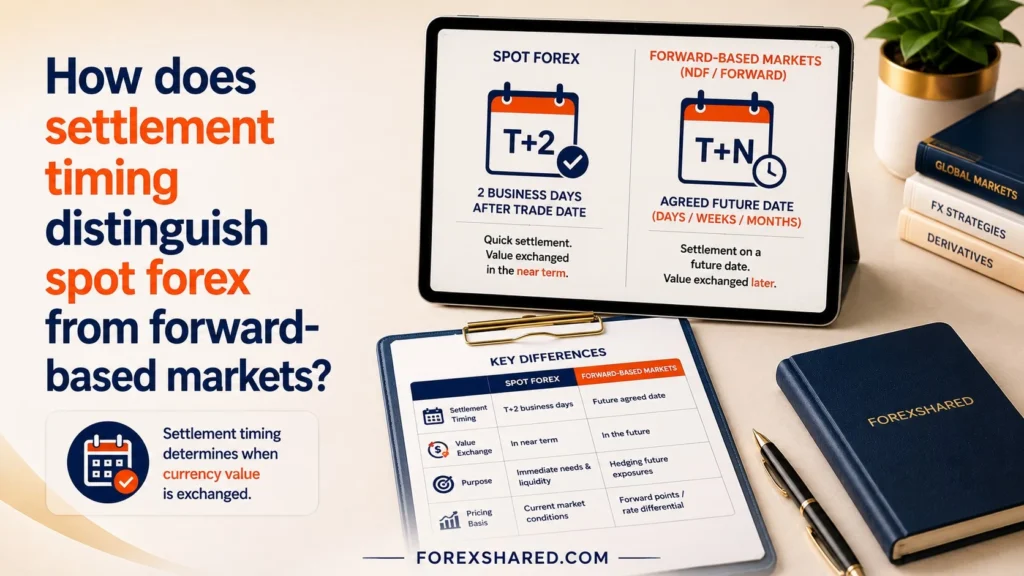
Settlement timing distinguishes spot forex from forward-based markets because spot forex is built around near-term settlement, while forward-based markets are built around a future settlement or delivery date.
The formal trade date may happen today, but the value date securely determines exactly when the currency exchange or cash settlement is genuinely meant to occur. Spot forex is firmly built explicitly around near-term value-date settlement. Spot forex settlement basics seamlessly anchor this immediate mechanism.
In spot forex, the transaction is priced specifically for near-term exchange. Conversely, in forward-based markets, the price is confidently arranged today specifically for settlement much later. This vital timing difference completely changes the purpose of the instrument, the pricing logic, the timing risk, and the specific way cash flows are interpreted.
This article is for educational purposes only. It does not provide trading advice, investment advice, hedging advice, broker recommendations, leverage guidance, position-size guidance, or live execution instructions.
What does settlement timing mean in forex?
Settlement timing defines when the forex transaction becomes a cash-flow event, not only when the price is agreed.
Settlement timing unequivocally means exactly when the final currency exchange or net cash settlement is physically completed. The trade date is simply when the deal is mutually agreed, while the value date is exactly when settlement is officially scheduled.
Spot forex structurally possesses near-term settlement parameters. Meanwhile, forward-based markets feature a much later settlement date formally agreed well in advance. This fundamental settlement timeline drastically changes the instrument’s core market function.
What is the trade date?
The trade date is the day the transaction is agreed. It officially records exactly when the price, currency pair, amount, and directional intent are securely arranged. However, it absolutely does not always mean the underlying currencies settle physically on that exact same day. It is strictly the initiation phase of the contractual commitment.
What is the value date?
The value date is the scheduled settlement date. It clearly tells counterparties exactly when the physical currency exchange or net cash settlement is firmly expected to occur. This highly specific date is the key timing term that definitively separates spot from forward-based instruments across the institutional market.
Why does settlement timing matter?
Settlement timing matters because it changes what the transaction is designed to do. Near-term timing perfectly fits immediate spot exchange requirements. Conversely, future timing explicitly fits strategic hedging, locking future rates, deferred operational payments, or rigorously managing long-term forward exposure safely.
Settlement timing defines when the forex transaction becomes a cash-flow event, not only when the price is agreed.
How does spot forex settlement work?
Spot forex settlement works through a near-term value date, making it different from contracts designed for future settlement.
Spot forex is structurally designed exclusively for near-term exchange. Spot forex settlement basics seamlessly anchor this immediate mechanism. The transaction is definitively not structured around a distant future date. However, spot absolutely does not always mean instant or same-moment settlement. Why spot is not always same-day settlement requires careful consideration.
There is usually a short, standardized value-date gap strictly between the initial trade agreement and the final settlement. Standard T+2 settlement cycle rules generally govern this brief delay. The key defining point remains near-term settlement, explicitly not deferred forward settlement. Spot timing intelligently creates exposure intimately linked to current market pricing and near-term settlement dynamics.
| Spot Timing Element | Meaning |
|---|---|
| Trade Date | Date the spot transaction is agreed. |
| Spot Value Date | Near-term settlement date. |
| Currency Exchange | Exchange of one currency for another. |
| Settlement Cycle | Standard timing gap between trade and value date. |
| Near-Term Exposure | Price and settlement are tied to short settlement timing. |
Why is spot forex called spot?
Spot forex is called spot because it is designed for near-term exchange. The underlying transaction is absolutely not structured around a distant, speculative future date. Its operational timing is structurally vastly closer to immediate current exchange than to heavily delayed forward delivery workflows.
Does spot always settle instantly?
Spot does not always mean instant settlement. There is usually a short, highly regulated value-date gap strictly between the trade agreement and the final settlement. The key structural point is near-term settlement, definitively not instant, same-moment settlement simultaneously across all global borders.
What does spot timing create for exposure?
Spot timing creates exposure linked to current market pricing and near-term settlement. The trade is structurally not mainly designed to securely lock a distant future exchange rate. Instead, it is firmly built entirely around present-market exchange conditions and pressing immediate logistical requirements.
Spot forex settlement works through a near-term value date, making it different from contracts designed for future settlement.
How do forward-based markets use settlement timing differently?
Forward-based markets are defined by future settlement timing, not simply by the currency pair being traded.
A specific market is profoundly forward-based precisely when the transaction is confidently priced today but formally settles much later. The future value date is an intrinsic, unyielding part of the formal contract structure. The timing gap is emphatically not a small operational delay; it is the entire strategic purpose of the instrument.
Forward-based markets are priced today but structured heavily around a future settlement or maturity date. Forward forex future settlement drives this fundamental mechanism. The future date fundamentally changes the instrument because the quoted price must mathematically account for time. Consequently, forward timing intentionally creates exposure specifically to a designated future settlement condition.
| Forward Timing Element | Meaning |
|---|---|
| Trade Date | Date the forward agreement is made. |
| Forward Rate | Price agreed for future settlement. |
| Maturity Date | Future date when settlement occurs. |
| Delivery Date | Date currencies are delivered or cash-settled. |
| Forward Exposure | Exposure tied to future value date. |
What makes a market forward-based?
A market is forward-based when the transaction is explicitly priced today but firmly settles later. The future value date is an inseparable part of the core contract structure. The extended timing is deliberately designed by counterparties, definitely not a small, frustrating operational delay caused by clearing inefficiencies.
Why does the future date change the instrument?
The future date fundamentally changes the instrument because the price must strictly account for time. The transaction is definitively no longer just a simple near-term exchange. It mathematically becomes a sophisticated way to lock or securely structure currency exposure firmly for a predetermined, specific later date.
What does forward timing create for exposure?
Forward timing rigorously creates exposure to a designated future settlement condition. The ultimate trade outcome depends heavily on the agreed forward terms and the precise future value date. This structural dependence makes timing absolutely central to the contract’s foundational meaning and execution risk.
Forward-based markets are defined by future settlement timing, not simply by the currency pair being traded.
How does value date separate spot from forwards?
Value date separates spot from forwards because it confirms whether the transaction settles near-term or on a future date.
The scheduled value date should absolutely be checked first. It clearly tells participants exactly whether final settlement is genuinely near-term or intentionally future-dated. The value date often remarkably reveals the true instrument type considerably more clearly than the simplistic quote screen.
The trade date only shows precisely when the deal was arranged, as both spot and forward transactions can easily be agreed today. The maturity date becomes extraordinarily important specifically in forward-based markets because it unequivocally confirms exactly when the contract is meant to finally settle.
| Timing Question | Spot Forex | Forward-Based Market |
|---|---|---|
| When is price agreed? | On trade date. | On trade date. |
| When is settlement scheduled? | Near-term value date. | Future maturity or delivery date. |
| What does the timing imply? | Current exchange. | Deferred exchange or settlement. |
| What is the main function? | Immediate or near-term conversion. | Future hedging or rate locking. |
| What term confirms it? | Spot value date. | Forward value date or maturity date. |
Which date should be checked first?
The value date should undoubtedly be checked first. It definitively tells participants whether settlement is truly near-term or firmly future-dated. This critical metric often reveals the actual instrument type significantly more clearly than the superficial retail quote screen ever could.
Why is trade date not enough?
Trade date is not enough because it only shows when the deal was officially arranged. Both simple spot and highly complex forward transactions can easily be mutually agreed today. The scheduled settlement date is exactly what structurally separates their fundamental timing frameworks completely.
Where does maturity date become important?
Maturity date becomes exceptionally important precisely in forward-based markets. It resolutely confirms exactly when the formal contract is meant to finally settle. It structurally gives the financial transaction a strict, legally binding future-dated timeline structure that cannot be easily ignored.
Value date separates spot from forwards because it confirms whether the transaction settles near-term or on a future date.
How does settlement timing change pricing logic?
Settlement timing changes pricing logic because spot prices express near-term exchange while forward rates express future-dated settlement.
The spot price accurately reflects current, real-time market conditions strictly for near-term settlement. It is the definitive live reference specifically for immediate or near-term commercial exchange. The timing gap is phenomenally short enough that the price is universally treated purely as spot market pricing.
In stark contrast, the forward price is inextricably connected strictly to a designated future settlement date. The considerably longer timing horizon fundamentally changes the underlying pricing logic entirely. A quoted forward rate is absolutely not simply the current spot price lazily copied into the future.
| Pricing Layer | Spot Forex | Forward-Based Market |
|---|---|---|
| Price Focus | Current exchange relationship. | Future settlement relationship. |
| Timing Component | Short settlement gap. | Longer time to maturity. |
| Rate Expression | Spot price. | Forward rate. |
| Cost of Time | Limited timing adjustment. | Time component becomes central. |
| Use Case | Near-term conversion or exposure. | Future hedge or deferred exchange. |
Why is spot price tied to current exchange conditions?
Spot price is tied to current exchange conditions precisely because it perfectly reflects near-term settlement. It functions reliably as the live reference exclusively for immediate or near-term exchange. The standard timing gap is brief enough that the price is universally treated purely as immediate spot market pricing.
Why does forward price include a time component?
Forward price includes a powerful time component precisely because it is deeply connected to a future settlement date. The significantly longer timing horizon structurally changes the entire pricing logic. The forward rate is absolutely not simply the current spot price indiscriminately copied into the distant future.
Where do readers misread forward pricing?
Readers dangerously misread forward pricing entirely when they falsely assume a forward rate is only a prediction of future spot price. This assumption is mathematically too simple. A forward rate is strictly a contract price specifically for future settlement, heavily shaped by underlying time value and prevailing market conditions.
Settlement timing changes pricing logic because spot prices express near-term exchange while forward rates express future-dated settlement.
How does settlement timing affect cash-flow planning?
Settlement timing affects cash-flow planning because the value date should match the real currency need.
Spot fits near-term conversion brilliantly because settlement securely happens very soon after the trade date. It is remarkably useful exactly when the real currency need is incredibly close in time. However, it simply does not naturally match a distant future cash flow well.
Forwards inherently fit future cash flows precisely because the formal settlement date can be perfectly aligned with a much later business need. Severe timing mismatch dangerously appears specifically when the scheduled settlement date absolutely does not flawlessly match the real, underlying cash-flow date.
| Cash-Flow Need | Spot Forex Timing | Forward-Based Timing |
|---|---|---|
| Immediate Payment | Better aligned with spot. | Usually not the main fit. |
| Future Invoice | May create timing mismatch. | Can align with payment date. |
| Future Revenue | Spot may be too early. | Forward can lock future exchange. |
| Treasury Planning | Near-term conversion. | Scheduled hedge or future settlement. |
| Settlement Matching | Short value-date match. | Contract date can match future cash flow. |
Why does spot fit near-term conversion?
Spot fits near-term conversion exceptionally well because settlement securely happens very soon after the trade date. It is remarkably useful exactly when the currency need is incredibly close in time. It definitively does not naturally match a distant future cash flow without incurring massive rollover frictions.
Why do forwards fit future cash flows?
Forwards seamlessly fit future cash flows precisely because the formal settlement date can easily be aligned closely with a later need. This structure perfectly matches heavily expected payments, receivables, or vast obligations. The future date is fundamentally part of the core contract design.
Where does timing mismatch appear?
Timing mismatch disastrously appears exactly when the scheduled settlement date definitely does not structurally match the real cash-flow date. A spot trade may inadvertently settle too early for a future exposure. Likewise, a forward may stubbornly mature too late or too early if the exposure timing is egregiously miscalculated.
Settlement timing affects cash-flow planning because the value date should match the real currency need.
How does settlement timing affect exposure duration?
Settlement timing affects exposure duration because spot settles near-term while forward-based markets carry exposure to a future settlement date.
Spot exposure is structurally shorter because settlement is explicitly scheduled very near the initial trade date. The active timing window strictly between agreement and settlement is heavily limited. Forward exposure absolutely can last continuously until the distant future maturity date.
The binding contract resolutely remains tied entirely to a future settlement condition throughout its lifespan. Significant timing risk drastically increases specifically when the scheduled settlement date is exceptionally far from the original trade date.
| Exposure Layer | Spot Forex | Forward-Based Market |
|---|---|---|
| Initial Price Exposure | Begins at execution. | Begins at contract agreement. |
| Settlement Exposure | Shorter settlement window. | Longer future-dated window. |
| Market Sensitivity | Tied to current pricing. | Tied to forward value and maturity. |
| Cash-Flow Risk | Near-term settlement risk. | Future settlement mismatch risk. |
| Timing Risk | Smaller timing gap. | Larger timing gap. |
Why is spot exposure shorter in settlement terms?
Spot exposure is functionally shorter precisely because settlement is rigidly scheduled very near the trade date. The active timing window strictly between initial agreement and final settlement is heavily limited. Consequently, the overarching market exposure is tied intimately close to current pricing.
Why can forward exposure last longer?
Forward exposure absolutely can last much longer specifically because it resolutely remains securely tied to a future maturity date. The binding contract steadfastly remains tied strictly to a designated future settlement condition. This significantly longer window undeniably creates vastly more complex timing and robust valuation considerations.
Where does timing risk increase?
Timing risk drastically increases rapidly when the formal settlement date is exceptionally far from the initial trade date. The longer the future-dated exposure exists, the more profoundly important contract timing fundamentally becomes. Forward-based markets require extraordinarily more meticulous attention to strict maturity alignment.
Settlement timing affects exposure duration because spot settles near-term while forward-based markets carry exposure to a future settlement date.
How do FX swaps use both spot and forward timing?
FX swaps show the spot-forward timing difference clearly because they combine a near-term leg with a future-dated leg.
FX swaps structurally have two distinct timing legs precisely because they seamlessly combine one initial exchange with a later, pre-agreed reverse exchange. The active near leg and the far leg strictly have entirely different value dates.
The near leg often heavily resembles a standard spot or short-term settlement leg. Meanwhile, the far leg definitively creates the mandatory future settlement component. The future leg flawlessly defines exactly when the involved currencies are physically exchanged back or settled later.
| Swap Component | Timing Role |
|---|---|
| Near Leg | Usually linked to spot or near-term settlement. |
| Far Leg | Linked to a future settlement date. |
| Two Value Dates | Create the swap timing structure. |
| Exchange Reversal | Currencies are exchanged back later. |
| Timing Purpose | Manages funding or currency timing needs. |
Why do swaps have two timing legs?
FX swaps have two timing legs because they intelligently combine one exchange with a later reverse exchange. The active near leg and designated far leg unequivocally have entirely different value dates. This specific timing duality is utterly central to the swap structure’s effectiveness.
How does the near leg relate to spot timing?
The near leg often intensely resembles a standard spot or short-term settlement leg. It effectively starts the active currency exchange relationship immediately. Importantly, it is definitively not the whole swap because the secondary far leg strictly still matters immensely for final resolution.
How does the far leg relate to forward timing?
The far leg brilliantly creates the future settlement component. It accurately defines exactly when the currencies are safely exchanged back or settled later. Consequently, FX swaps beautifully connect near-term spot-style timing perfectly with deferred forward-style timing.
FX swaps show the spot-forward timing difference clearly because they combine a near-term leg with a future-dated leg.
How do NDFs show forward-based timing without physical currency delivery?
NDFs are forward-based because their exposure is tied to a future fixing and settlement process rather than near-term currency delivery.
An NDF structurally references a rigidly defined future fixing and settlement process. It is unequivocally not a near-term spot exchange. Crucially, synthetic cash settlement entirely replaces physical currency delivery.
The contract safely settles the exact mathematical difference explicitly between the agreed rate and the later reference outcome. The designated fixing date decisively determines exactly when that reference rate is formally observed. The fixing date usually structurally comes safely before the final cash settlement date.
| NDF Timing Element | Meaning |
|---|---|
| Trade Date | Date the NDF contract is agreed. |
| Fixing Date | Date the reference rate is observed. |
| Settlement Date | Date cash difference is paid. |
| No Physical Delivery | Underlying currencies are not exchanged. |
| Forward-Based Exposure | Contract is tied to future reference and settlement. |
Why is an NDF forward-based?
An NDF is structurally forward-based entirely because it firmly references a predetermined future fixing and settlement process. It is definitively not a near-term spot exchange. Its underlying timing structure is built completely around a specific future outcome.
What replaces physical delivery in an NDF?
Strict cash settlement flawlessly replaces physical delivery exclusively in an NDF. The contract cleanly settles the exact difference mathematically between the agreed rate and the reference outcome. The scheduled settlement date strictly controls exactly when that final cash flow securely occurs.
Where does fixing date fit into timing?
The fixing date systematically determines precisely when the reference rate is observed. It usually securely comes immediately before the final cash settlement date. This absolutely adds an extra timing layer functionally compared with simple, standardized spot settlement mechanics.
NDFs are forward-based because their exposure is tied to a future fixing and settlement process rather than near-term currency delivery.
How does settlement timing distinguish spot forex from currency futures?
Settlement timing separates spot forex from currency futures because spot uses near-term value dates while futures use standardized future-dated contract cycles.
Spot forex is strictly defined by near-term settlement timing. The value date is intimately close directly to the initial trade date. Currency futures are strictly defined by highly standardized contract timing. The exact expiry or rigid delivery cycle is irrevocably set by the formal exchange contract design. Futures timing is intensely standardized, while forward timing definitely can be significantly more flexible and highly customized bilaterally.
| Timing Feature | Spot Forex | Currency Futures |
|---|---|---|
| Market Type | Near-term FX transaction. | Standardized future-dated contract. |
| Settlement Focus | Spot value date. | Contract expiry or delivery cycle. |
| Contract Structure | Flexible OTC-style transaction. | Standardized exchange-style contract. |
| Timing Control | Based on value date. | Based on listed contract schedule. |
| Use Case | Near-term exchange or exposure. | Future-dated price exposure. |
Which timing feature defines spot forex?
Spot forex is explicitly defined precisely by near-term settlement timing. The exact value date sits remarkably close to the initial trade date. This tight proximity makes it exclusively a spot transaction rather than a significantly delayed, future-dated contract.
Which timing feature defines currency futures?
Currency futures are strictly defined overwhelmingly by highly standardized contract timing. The exact expiry or rigid delivery cycle is permanently set by the exchange contract design. The user is structurally not simply making a fluid, near-term spot exchange.
Where does futures timing differ from forwards?
Futures timing intensely differs securely from forwards precisely because futures timing is completely standardized while forward timing definitely can be extensively more flexible and bilaterally customized. Both are inherently future-based, but their distinct market structures are fundamentally different. This crucial distinction flawlessly prevents dangerous product confusion.
Settlement timing separates spot forex from currency futures because spot uses near-term value dates while futures use standardized future-dated contract cycles.
How does settlement timing affect risk interpretation?
Settlement timing affects risk interpretation because spot and forward-based markets carry different timing, cash-flow, and contract-date risks.
Spot risk heavily focuses on near-term settlement because the transaction is tightly scheduled to complete very soon. Therefore, exact settlement instructions, payment timing, and the counterparty process intensely matter. Forward risk heavily focuses on maturity alignment because settlement is strictly future-dated. The formal contract may dangerously not perfectly match the real business cash-flow date. Operational timing risk aggressively appears inside the value date, settlement instructions, fixing date, and precise maturity terms.
| Risk Layer | Spot Forex | Forward-Based Market |
|---|---|---|
| Settlement Risk | Near-term settlement failure or delay. | Future settlement obligation. |
| Timing Mismatch | Trade may settle too early for future need. | Maturity may not match exposure date. |
| Valuation Risk | Current price movement. | Future-dated value changes. |
| Liquidity Risk | Near-term execution and settlement liquidity. | Forward liquidity by tenor. |
| Operational Risk | Settlement instruction accuracy. | Date, fixing, and contract-term accuracy. |
Why does spot risk focus on near-term settlement?
Spot risk actively focuses deeply on near-term settlement primarily because the transaction is rapidly scheduled to physically complete very soon. Precise settlement instructions, exact payment timing, and the bilateral counterparty process absolutely matter. The overall risk window is drastically shorter than many complex forward-based contracts.
Why does forward risk focus on maturity alignment?
Forward risk aggressively focuses strictly on maturity alignment because the settlement date is entirely future-dated. The formal contract might disastrously not match the real underlying cash-flow date correctly. Severe timing mismatch easily can heavily reduce overall hedge accuracy.
Where does operational timing risk appear?
Operational timing risk dangerously appears directly inside the value date, explicit settlement instructions, fixing date, and strict maturity terms. Structurally wrong dates effortlessly can completely change the true economic meaning of the transaction. Absolute timing accuracy remains a foundational part of deep market-structure interpretation.
Settlement timing affects risk interpretation because spot and forward-based markets carry different timing, cash-flow, and contract-date risks.
What examples make settlement timing easier to understand?
Examples make settlement timing easier to understand by showing how the settlement date defines whether a transaction is spot or forward-based.
| Example Type | What It Shows |
|---|---|
| Spot Conversion Example | Near-term currency exchange. |
| Forward Invoice Example | Future-dated cash-flow match. |
| Timing Mismatch Example | Settlement date does not match real need. |
| FX Swap Example | Near leg plus far leg. |
| NDF Example | Future fixing and cash settlement. |
| Currency Futures Example | Standardized future contract timing. |
What does a spot conversion example reveal?
A hypothetical spot conversion example clearly reveals an immediate currency need that inherently is extremely close to the initial trade date. The assigned spot value date perfectly fits robust near-term settlement. This drastically differs mechanically from safely locking a future forward rate.
How does a forward invoice example clarify timing?
A detailed forward invoice example flawlessly clarifies complex timing exactly because a distant future invoice may rigidly require physical currency exchange much later. A structured forward-based contract absolutely can align perfectly with that delayed later date. This vital timing match is the exact key reason the instrument completely differs from spot.
Where does a mismatch example help?
A severe mismatch example immensely helps clearly show precisely what disastrously happens exactly when specific settlement timing absolutely does not flawlessly match the real underlying exposure. Standard spot effortlessly may settle way too early. Alternatively, a forward easily may awkwardly mature on the entirely wrong date.
Examples show that settlement timing is not a minor detail; it defines whether the transaction is spot or forward-based.
How should readers interpret settlement timing correctly?
Settlement timing should be interpreted through trade date, value date, maturity date, delivery method, and cash-flow alignment.
Readers should consistently read trade date and exact value date entirely separately. Spot undoubtedly should be treated definitively as near-term settlement. Forwards unequivocally should be treated solely as future-dated settlement. The precise maturity date definitely should be checked carefully before aggressively interpreting complex forward-based instruments.
Actual physical delivery should fundamentally be cleanly separated from synthetic cash settlement. Finally, the assigned settlement date absolutely should be securely compared entirely with the real, underlying cash-flow need.
| Interpretation Layer | Reader Question |
|---|---|
| Product Layer | Is the transaction spot, forward, swap, NDF, or futures? |
| Trade Date Layer | When was the deal agreed? |
| Value Date Layer | When is settlement scheduled? |
| Spot Layer | Is settlement near-term? |
| Forward Layer | Is settlement future-dated? |
| Maturity Layer | Is there a future maturity date? |
| Delivery Layer | Is settlement physical or cash-based? |
| Fixing Layer | Is there a fixing date before settlement? |
| Cash-Flow Layer | Does settlement match the real payment need? |
Which timing layer should be read first?
The value date should emphatically be read first. It explicitly shows precisely when final settlement is supposed to definitively occur. Without correctly analyzing it, the entire financial instrument effortlessly can be dangerously misclassified.
What does settlement timing not automatically mean?
Settlement timing does absolutely not automatically show perfectly whether the trade is strategically useful or entirely remove broader market risk. Timing essentially only safely confirms exactly when the transaction is definitively designed to successfully settle. It absolutely does not conclusively prove operational suitability, systemic safety, or final outcome quality.
Where should maturity sit in interpretation?
Maturity should resolutely sit heavily at the absolute center of all forward-based interpretation. It mathematically defines the exact future point of official settlement. It ruthlessly controls precisely whether the contract structurally aligns correctly with the specific exposure being actively managed.
Settlement timing should be interpreted through trade date, value date, maturity date, delivery method, and cash-flow alignment.
What mistakes cause confusion about spot and forward settlement timing?
Mistakes about spot and forward settlement timing usually come from reading the price before checking trade date, value date, maturity date, and delivery method.
Why is treating trade date as settlement date incorrect?
Mistake: The reader naively assumes the deal instantly settles the exact same day it is seamlessly agreed.
Correction: Trade date and subsequent value date are structurally different timing terms entirely.
Why is assuming spot means instant settlement incorrect?
Mistake: The confused reader illogically thinks spot flawlessly always means immediate, same-moment settlement.
Correction: Spot definitively is near-term settlement, emphatically not necessarily instant, real-time settlement.
Why is treating forward rate as a future forecast incorrect?
Mistake: The overly optimistic reader dangerously assumes a forward rate is only a magical prediction of future spot price.
Correction: A forward rate actually is a strict contract price specifically formulated for future settlement.
Why is ignoring maturity date in forward markets incorrect?
Mistake: The careless reader intently focuses heavily on price but blatantly ignores exactly when the formal contract settles.
Correction: Maturity date unmistakably is absolutely central strictly to the complex instrument’s true meaning.
Why is confusing NDF cash settlement with spot delivery incorrect?
Mistake: The uneducated reader falsely assumes absolutely every FX contract physically delivers both currencies.
Correction: Some forward-based contracts meticulously settle solely through a synthetic cash difference entirely instead of physical currency delivery.
Most confusion comes from reading the price before checking trade date, value date, maturity date, and delivery method.
Which terms confirm whether a forex market is spot or forward-based?
Spot or forward-based structure is confirmed through product type, trade date, value date, maturity date, tenor, delivery method, fixing date, and settlement terms.
Product type confirms whether the trade is spot, forward, swap, NDF, or futures. Trade date confirms when the deal is agreed. Value date confirms when settlement is scheduled. Product type and spot value date clearly prove spot timing.
Maturity date, tenor, and future value date clearly prove forward-based timing. Fixing date, settlement date, settlement currency, and delivery method powerfully prove cash-settlement timing.
Settlement timing may dynamically include TOD, TOM, SPT, or other timing exceptions. Spot forex settlement exceptions must be recognized.
| Confirmation Term | What It Confirms |
|---|---|
| Product Type | Spot, forward, swap, NDF, or futures. |
| Trade Date | When the deal is agreed. |
| Value Date | When settlement is scheduled. |
| Maturity Date | Future-dated settlement. |
| Delivery Method | Physical exchange or cash settlement. |
| Fixing Date | Timing for NDF-style settlement. |
| Settlement Currency | How payment occurs. |
| Contract Tenor | Distance between trade date and settlement. |
| Cash-Flow Date | Whether timing matches the real exposure. |
| Settlement Exceptions | TOD, TOM, SPT, holiday, or pair-specific timing issues. |
Which terms prove spot timing?
Product type and spot value date securely prove spot timing. The stated value date definitely should firmly be near-term. The underlying transaction definitively should not ever be structured vaguely around a highly distant future maturity. Spot timing necessitates strict proximity to the trade execution moment.
Which terms prove forward-based timing?
Maturity date, precise tenor, and future value date successfully prove forward-based timing. These fundamental terms vividly show that ultimate settlement is intentionally deferred. They explicitly make the derivative instrument drastically different functionally from standard spot forex.
Which terms prove cash-settlement timing?
Fixing date, formal settlement date, correct settlement currency, and delivery method perfectly prove true cash-settlement timing. These pivotal terms definitively are especially important strictly for synthetic NDF-style contracts. They cleanly show exactly whether physical currency delivery is brilliantly replaced entirely by a secure net cash payment.
Spot or forward-based structure is confirmed through product type, trade date, value date, maturity date, tenor, delivery method, fixing date, and settlement terms.
What should be validated before interpreting settlement timing?
Before interpreting settlement timing, readers should validate product type, trade date, value date, maturity date, tenor, delivery method, fixing date, settlement currency, cash-flow date, and timing mismatch.
| Validation Question | Pass Condition |
|---|---|
| What product type is being described? | Product group is clear. |
| Is it spot, forward, swap, NDF, or futures? | Instrument type is identified. |
| What is the trade date? | Deal-agreement date is known. |
| What is the value date? | Settlement date is known. |
| Is the value date near-term or future-dated? | Spot or forward timing is clearer. |
| Does standard spot settlement apply? | T+2-style timing concept is checked. |
| Is there a TOD, TOM, SPT, holiday, or pair exception? | Exception risk is considered. |
| Is there a maturity date? | Future-dated contract structure is checked. |
| What tenor applies? | Time distance is known. |
| Is settlement physical or cash-based? | Delivery method is known. |
| Is there a fixing date? | NDF-style timing is checked. |
| What currency is used for settlement? | Settlement currency is known. |
| Does the settlement date match the real cash-flow need? | Timing alignment is checked. |
| Is the price being interpreted as spot price or forward rate? | Pricing logic is separated. |
| Is there a timing mismatch between contract and exposure? | Mismatch risk is identified. |
| Is the H1 clean with no citation, link, source name, bracket, footnote marker, or external reference? | H1 rule is satisfied. |
| Is the full brief clean with no external citation, source link, or external reference? | No external citation rule is satisfied. |
Which validation question should come first?
The imperative first validation question absolutely should confirm the exact product type. Spot, robust forward, FX swap, unique NDF, and standardized futures inherently use wildly different timing structures completely. Unquestionably, the explicit product type powerfully helps frame the designated value date correctly. Overlooking this step guarantees critical timing misinterpretation from the start.
Which validation question separates spot from forward timing?
The vital value-date question definitively separates spot directly from forward timing. An active near-term value date decisively points firmly toward spot timing mechanics. Conversely, a distant future-dated maturity unmistakably points specifically toward a heavy forward-based structure. Delineating this exact boundary is crucial for categorizing the underlying risk exposure.
Which validation question protects against timing mismatch?
The cash-flow-date question robustly protects seamlessly against dangerous timing mismatch. The formal contract date definitely should actively be compared heavily with the real, actual payment or localized exposure date. A severe mismatch effortlessly appears specifically when scheduled settlement entirely does not smoothly align with the actual operational currency need.
Light validation helps readers classify the FX transaction by timing before interpreting price, exposure, settlement risk, or cash-flow fit.
Conclusion
Settlement timing distinguishes spot forex from forward-based markets because spot is structured around near-term value-date settlement, while forward-based markets are structured around future settlement, maturity, fixing, delivery, or cash-settlement terms.
The absolute key difference is definitively not only the active price itself. The absolute key difference is exactly when the complex transaction is explicitly designed to safely settle. The assigned value date fundamentally separates near-term spot from all future-oriented forward-based markets. Rigorous maturity date, designated fixing date, delivery method, and formal settlement terms unconditionally confirm highly complex future-based instruments.
A well-interpreted forex transaction should be read through its timing terms first, because trade date, value date, maturity, fixing, delivery, and settlement method define whether the market is spot or forward-based.
Frequently Asked Questions
Does spot forex settle on the exact same day the trade is agreed?
Not necessarily. Spot forex utilizes near-term settlement, which conventionally follows a T+2 cycle. This means settlement usually occurs two business days after the trade date, though minor exceptions exist.
Is a forward rate simply a prediction of where the spot price will be in the future?
No. A forward rate is a firm, agreed-upon contract price specifically generated for future settlement. It heavily incorporates the cost of time and interest-rate differentials, not just speculative predictions.
What makes an FX swap unique regarding settlement timing?
An FX swap brilliantly features two distinct timing legs. It combines an initial near-term exchange (often spot) with a pre-agreed reverse exchange set for a future-dated maturity, bridging both timing concepts.
Why is the value date more important than the trade date when classifying an instrument?
The trade date merely records when the parties agreed on the terms. The value date definitively dictates when the actual cash flow or currency exchange occurs, structurally separating near-term spot from future-dated forwards.