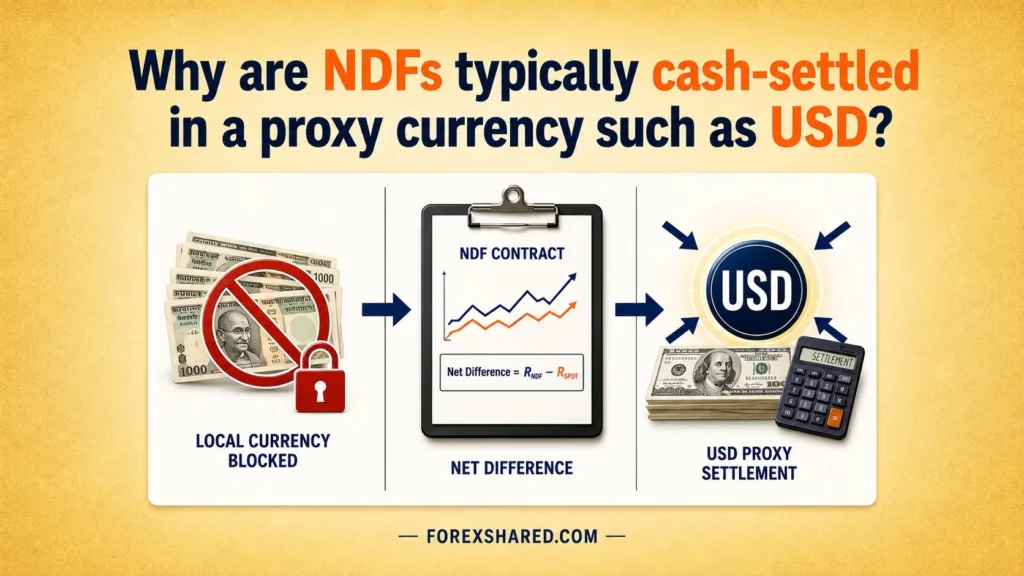
Why Are NDFs Typically Cash-Settled in a Proxy Currency Such as USD?
NDFs are typically cash-settled in a proxy currency such as USD because the referenced local currency may be restricted, difficult to transfer offshore, or impractical to deliver through normal settlement channels. When multinational corporations or global hedge funds require exposure to highly guarded emerging markets, forcing physical capital across those strictly monitored borders creates an insurmountable logistical catastrophe.
To navigate these sovereign financial blockades, the non-deliverable forward structure deliberately severs the physical delivery requirement from the economic exposure. The contract retains total sensitivity to the restricted local currency's market fluctuations, yet executes the terminal payout strictly via a net cash settlement in a universally accessible, highly liquid settlement currency.
NDFs act as contracts for the difference between an agreed exchange rate and the spot rate at maturity, settled through a single proxy payment without funding in the underlying currencies (BIS).
This article is educational only and does not constitute financial advice. Trading foreign exchange on margin carries a high level of risk.
What does proxy-currency cash settlement mean in an NDF?
Proxy-currency cash settlement means the NDF pays the final settlement amount in a separate tradable currency while the referenced local currency still drives the economic result. The contract entirely strips away the obligation to swap gross principal volumes. Recognizing NDF contract structure requires accepting that the asset dictating the pricing variance is deliberately disjointed from the asset used to execute the final payment.
Which currency creates the exposure, and which currency makes the payment?
The referenced local currency creates the exposure, while the proxy currency carries the final payment. If you initiate a contract on the Indian Rupee (INR), the fluctuation of the Rupee perfectly controls your profit or loss. However, the ultimate compensation is physically wired to you using the secondary proxy asset, sidestepping the Rupee entirely.
Where does the non-deliverable feature appear?
The non-deliverable feature appears because the local currency is referenced but not physically transferred. Both counterparties mathematically agree on a future valuation, yet at maturity, the local banking infrastructure remains completely untouched. The trade executes strictly as a synthetic off-shore derivative.
What makes the proxy currency practical?
The proxy currency is practical because both parties can usually pay, receive, and account for it more easily than the restricted local currency. It operates across open, frictionless international networks, allowing institutions to neutralize their risk without applying for complex onshore capital transfer permits.
Proxy-currency cash settlement keeps local-currency exposure but uses a separate tradable currency to complete payment.
Why is USD often used as the settlement currency?
USD is often used as the settlement currency because it is widely accepted in international FX settlement and is easier for many offshore counterparties to pay or receive than a restricted local currency. It serves as the ultimate benchmark liquidity vehicle, seamlessly absorbing the massive transactional weight of institutional clearing systems.
Which market habit makes USD a natural proxy?
USD is a natural proxy because many offshore FX counterparties already use it for settlement, funding, collateral, and reporting. Corporate treasuries uniformly maintain substantial USD reserves. Transacting the NDF offset in Dollars intrinsically aligns the derivative with the institution's primary accounting baseline.
What does USD settlement avoid operationally?
USD settlement avoids the need to deliver the restricted local currency through local settlement channels. It definitively severs reliance upon opaque, heavily monitored foreign central banks, extinguishing the administrative friction of repatriating blocked capital.
Where can readers overstate USD’s role?
Readers overstate USD’s role when they assume USD settlement means the local currency no longer matters. While the greenback carries the physical value to the recipient's bank account, it exerts absolutely zero influence on the contract's actual profit/loss calculation. The volatility is entirely driven by the underlying, restricted asset.
USD is commonly used because it is practical for offshore cash settlement, while the local currency still drives the NDF’s economic result.
How does cash settlement replace local-currency delivery?
Cash settlement replaces local-currency delivery by turning the exchange-rate difference into a proxy-currency net payment. Bypassing gross transfer, the architecture zeroes in entirely on the profit or deficit generated over the duration of the contract. Mastering why No physical local-currency delivery is utilized sets the stage for defining the mechanical NDF settlement cash flows that follow.
Which rate anchors the agreement at trade start?
The agreed NDF rate anchors the contract by giving both parties the forward-style reference rate used for later comparison. Locked at inception, this metric crystallizes the exact exchange threshold required to break even. It serves as the unmoving foundation that terminal reality is measured against.
Where does the fixing rate turn exposure into payment?
The fixing rate turns exposure into payment by providing the final market reference used to determine the cash settlement. Captured objectively from a designated financial screen precisely on the fixing date, it resolves the pricing disparity. Subtracting the initial agreed rate from this fixing rate actively unlocks the final payable variance.
What makes the settlement net instead of deliverable?
The settlement is net because only the difference is paid rather than exchanging the full currency amounts. If the resulting calculation dictates a fifty-thousand-dollar deficit against a ten-million-dollar notional frame, only the fifty-thousand-dollar increment is physically transferred.
Cash settlement replaces local-currency delivery by converting the rate difference into a proxy-currency payment.
Why does restricted-currency access make proxy settlement necessary?
Restricted-currency access makes proxy settlement necessary when offshore counterparties need exposure to a local currency but cannot practically deliver or receive that currency. Emerging market governments routinely clamp down on currency outflows to combat rampant speculation. Consequently, establishing an onshore bank account to clear funds physically transforms into an impossible bureaucratic blockade.
Which access problem does the NDF solve?
The NDF solves the access problem created when the user has currency exposure but lacks a practical delivery channel for the local currency. An international hedge fund may need to short a restricted asset, but since it possesses zero operational standing within that domestic market, the NDF proxy settlement grants it full market access synthetically.
Where does offshore settlement face the biggest constraint?
Offshore settlement faces its biggest constraint when counterparties cannot directly use the local payment system or freely transfer the local currency. Strict capital controls obliterate gross transfer pipelines, forcing traders to abandon deliverable parameters entirely.
What remains linked to the local market?
The fixing or reference rate remains linked to the local currency even though settlement occurs offshore. The payout math flawlessly relies upon the authentic, ground-truth value of the restricted asset, permanently anchoring the derivative to absolute reality.
Proxy settlement is necessary because NDF users often need local-currency exposure without direct local-currency settlement access.
How is proxy-currency settlement different from a deliverable forward?
Proxy-currency settlement differs from a deliverable forward because the NDF settles only the economic difference, while a deliverable forward exchanges the contracted currencies. Both vehicles utilize interest rate differentials to formulate pricing, but their termination sequences bifurcate violently.
| Contract Type | Maturity Outcome | Currency Transfer Logic |
|---|---|---|
| Deliverable Forward | Currencies are exchanged | Full delivery of contracted currencies |
| NDF | Difference is cash-settled | Proxy-currency net payment |
Which contract needs the actual local currency?
The deliverable forward needs the actual local currency when the contract requires physical exchange at maturity. For execution to successfully complete, deep cross-border reserves are fundamentally mandatory.
What does the NDF keep from forward logic?
The NDF keeps the future exchange-rate agreement but removes the physical delivery step. This preserves the absolute hedging integrity of the derivative while systematically decapitating the associated logistical risk.
Where does the proxy currency change the contract’s function?
The proxy currency changes the contract’s function by turning it into an economic exposure tool rather than a physical delivery contract. It functions uniquely to offset balance sheet volatility rather than to procure raw supply chain capital.
A deliverable forward settles through currency exchange, while an NDF settles the economic difference in a proxy currency.
When is proxy-currency settlement most useful?
Proxy-currency settlement is most useful when the user needs exposure to a local currency but does not need, or cannot access, physical delivery of that currency. Operating precisely within these specific macroeconomic constraints unlocks the derivative's unparalleled strategic utility.
When does a company need the hedge but not the currency?
A company may need the hedge but not the currency when its risk is economic exchange-rate movement rather than actual receipt of local currency offshore. Multinational manufacturers seeking to offset accounting losses driven by depreciating local revenues require immediate financial compensation, not the underlying restricted asset.
Where does an offshore investor benefit from USD settlement?
An offshore investor may benefit from USD settlement when direct local-currency access is restricted or operationally difficult. Speculative hedge funds routinely utilize the structure to extract profit from emerging market volatility entirely without breaching sovereign capital blockades.
Which situation still needs deliverable settlement?
Deliverable settlement is still needed when the user must actually pay or receive the local currency. If raw supply chains mandate procuring tangible capital to fund localized labor and manufacturing operations, the synthetic net offset of an NDF is practically worthless.
Proxy-currency settlement is most useful when the user needs currency exposure but not actual local-currency delivery.
What risks remain when an NDF settles in USD?
USD settlement makes NDFs operationally practical, but it does not remove market risk, counterparty risk, fixing-rate dependency, or basis risk. Severing physical delivery simply relocates the structural hazard rather than destroying it.
Which risk survives because the local currency still matters?
Market risk survives because the referenced local currency still drives the NDF outcome. The proxy payment flawlessly mimics whatever violent trajectory the restricted asset charts. A catastrophic onshore devaluation directly triggers an identical offshore net loss.
Where does the fixing rate become a dependency?
The fixing rate becomes a dependency because the final payment depends on the agreed reference source. Relying exclusively on central bank screens or Reuters fixes exposes the contract to data disruptions or systematic manipulation.
What does proxy settlement reduce but not eliminate?
Proxy settlement reduces local-currency delivery burden but does not eliminate counterparty performance risk or basis-risk concerns. If the opposing institution defaults, you forfeit the net USD payout. If the offshore NDF pricing inherently decouples from the onshore spot rate, unmitigated basis risk actively damages your hedge.
USD settlement makes NDFs easier to settle offshore, but important market, counterparty, fixing, and basis risks remain.
What examples make proxy-currency settlement easier to understand?
Examples make proxy-currency settlement easier to understand by showing how the NDF can reference a local currency while settling the final payment in USD or another tradable currency. Isolating execution logic within concrete scenarios clarifies institutional operations without deploying excessive calculations.
What does a restricted-currency example reveal?
A restricted-currency example reveals why the contract may need to reference a local currency without delivering it. If a firm operates across Chinese RMB parameters, but strict regulations prohibit exporting those raw funds seamlessly, the NDF guarantees the firm can still mitigate potential RMB depreciation via synthetic protection.
What does a USD-payment example reveal?
A USD-payment example reveals how the settlement amount can be paid without transferring the local currency. If the RMB depreciates massively against the Dollar, the offshore counterparty strictly deposits the exact net offset directly into the firm’s USD bank account. No RMB physically moves.
Where does the forward contrast become clearest?
The forward contrast becomes clearest at maturity: the deliverable forward exchanges currencies, while the NDF settles only the difference. Tracking the asset flow definitively distinguishes between physical volume logistics and proxy-payout efficiency.
Examples show that proxy-currency settlement preserves local-currency exposure while avoiding local-currency delivery.
How should readers interpret “cash-settled in USD” correctly?
“Cash-settled in USD” means USD carries the settlement payment, not that the local-currency exposure disappears. Comprehending this distinction definitively prevents dangerous misapplications of derivative capabilities.
Which currency should be treated as the exposure currency?
The referenced local currency should be treated as the exposure currency because its exchange-rate movement drives the outcome. The underlying asset commands the pricing grid entirely; the USD merely serves as the post-trade courier.
What does “cash-settled” not mean?
Cash-settled does not mean there is no currency risk, no local-currency reference, or full exchange of both currencies. The portfolio remains ruthlessly tethered to the volatile geopolitical movements impacting the designated restricted asset.
Where does the reader separate settlement from exposure?
The reader separates settlement from exposure by asking which currency determines the outcome and which currency carries the payment. Master this dual structure to confidently navigate off-shore hedging mechanisms.
“Cash-settled in USD” means USD settles the difference, while the local currency still drives the economic exposure.
What mistakes cause confusion about proxy-currency settlement?
Confusion about proxy-currency settlement usually comes from mixing up the currency that drives exposure with the currency used for payment. Eliminating these severe cognitive errors instantly fortifies your institutional understanding.
Assuming USD settlement means USD exposure only
Mistake: The reader thinks the local currency no longer matters.
Correction: The local currency still drives the fixing-based outcome. USD only acts as the delivery conduit.
Treating the proxy currency as the delivered currency pair
Mistake: The reader assumes USD settlement equals full currency exchange.
Correction: Only the net difference is paid in USD or another agreed currency, vastly minimizing capital outlay.
Ignoring the fixing source
Mistake: The reader focuses only on the proxy payment.
Correction: The fixing rate determines what that payment should be; manipulating the fix manipulates the payout.
Comparing NDFs with forwards before checking delivery
Mistake: The reader compares contract rates first.
Correction: Settlement structure should be understood before pricing comparison to avoid unviable operational assumptions.
Most confusion comes from mixing up the currency that drives exposure with the currency used for settlement.
How can readers fix misunderstanding before analyzing an NDF?
Readers can fix misunderstanding by identifying the exposure currency, settlement currency, fixing rate, and delivery structure before analyzing price or risk. Instituting this logical sequence immediately neutralizes analytical vulnerabilities.
What should be checked first in the contract terms?
The settlement clause should be checked first because it shows whether the contract settles in cash or through currency delivery. Do not proceed to evaluate spread or premium until this binary execution method is indisputably locked.
Which words signal proxy-currency settlement?
Terms such as settlement currency, fixing date, reference rate, cash settlement, and non-deliverable often signal proxy-currency settlement. Recognizing this vocabulary guarantees you are assessing an offshore synthetic contract.
Where should settlement purpose sit in the analysis?
Settlement purpose should come before pricing or hedge outcome because it explains what the contract actually does at maturity. A mathematically beautiful derivative is functionally useless if it legally forces a delivery your institution cannot perform.
The cleanest fix is to identify the exposure currency and settlement currency separately before interpreting the NDF.
What should be validated before accepting USD-settled NDF logic?
Before accepting USD-settled NDF logic, readers should confirm that the contract’s exposure currency, settlement currency, fixing source, and no-delivery structure are completely clear. Employing a strict verification sequence effectively eliminates hazardous institutional oversights.
NDFs are typically cash-settled in a proxy currency such as USD because the contract is rigorously designed to solve a delivery problem. It preserves pure exposure to the local currency’s exchange-rate movement while executing a drastically more practical currency to settle the net difference (IMF).
Proxy-Currency Settlement FAQs
Can an NDF be settled in a currency other than USD?
Yes. While USD serves as the overwhelmingly dominant international proxy due to global liquidity, counterparties can legally designate Euros, Yen, or any other freely tradable asset as the settlement currency.
If the payment is in USD, does that eliminate my exposure to the local currency?
Absolutely not. Your payout is purely determined by how violently the local currency moves against the initial agreed rate. The USD is strictly the courier vehicle carrying the payout, not the source of the financial risk.
Does proxy cash settlement reduce the risk of a counterparty default?
No. Even though you bypass onshore banking logistics, you still inherently rely upon the offshore counterparty to execute the USD wire on the settlement date. Counterparty credit risk remains fully active.