How Do Position-Size Tools Guide Lot Choice?
Position-size tools guide lot choice by connecting account size, risk limit, stop distance, pip-movement context, and trade exposure into a more structured sizing decision. Before a trader opens an order, these utilities act as the definitive mathematical checkpoint. They ensure that a conceptual market idea transforms accurately into a mathematically sound physical execution.
A position-size tool strictly supports lot-size judgment, not trade prediction. It does not dictate whether the market will move up or down, nor does it guarantee profitability. Instead, it processes raw chart geometry and personal equity boundaries, verifying that the selected lot category prevents the trader from unintentionally deploying catastrophic volume.
Lot choice directly affects trade exposure, pip sensitivity, margin pressure, and emotional control. This article provides a comprehensive mechanism-first breakdown of how position-size tools process these variables. We will analyze how account risk and stop distance drive the calculation, distinguish these tools from basic margin calculators, explore illustrative examples, fix poor sizing decisions, and establish a firm pre-use validation sequence.
This article is educational only and does not constitute financial advice. Trading foreign exchange on margin carries a high level of risk.
What does a position-size tool actually help traders choose?
A position-size tool helps traders choose a lot size that better matches the account, risk limit, stop distance, and trade plan. It functions purely as a sizing aid, stripping away the guesswork typically associated with manually allocating capital across divergent currency pairs (Investopedia).
Which part of the trade plan becomes clearer through the tool?
The tool makes lot choice clearer by showing whether the intended position size matches the account and planned risk. It brilliantly separates trade idea quality from position-size suitability. A fundamentally brilliant chart setup can still become an objectively terrible trade if it is severely oversized. The tool ensures the dimension of the entry aligns with survival.
Where does lot choice move from guesswork to structured sizing?
Lot choice becomes more structured when the trader connects account risk, stop distance, and pip impact before choosing size. Utilizing the calculator drastically reduces casual, spontaneous sizing. While the tool never guarantees a winning trade, it guarantees that the mathematical limits governing the failure scenario remain completely contained.
A position-size tool helps traders choose lot size by connecting the trade plan to account fit.
Why should lot choice start with account risk instead of trade confidence?
Lot choice should start with account risk because confidence does not reduce pip impact, stop distance, or market movement. No amount of absolute psychological certainty shields an active trade from sudden, adverse macroeconomic volatility. Utilizing a sizing tool anchors the decision to strict capital preservation (BabyPips).
What goes wrong when lot size follows conviction?
Lot size becomes unstable when it follows conviction instead of the trade plan. Emotional conviction heavily biases traders toward oversizing. When normal chart movement begins exerting pressure after entry, the overloaded position scale immediately forces catastrophic panic management, sabotaging the initial thesis.
Which risk boundary keeps lot choice realistic?
The risk boundary that keeps lot choice realistic is the trader’s pre-defined account risk limit. The position-size tool converts this firm boundary directly into sizing context. Establishing Position scale and risk guarantees the output respects the defensive foundation, regardless of how attractive the chart pattern appears.
Lot choice should begin with account risk because confidence cannot control market movement.
Which inputs make a position-size tool useful?
A position-size tool becomes useful when the trader enters accurate account, risk, stop distance, pair, and pip-movement information. Garbage inputs systematically produce garbage outputs. To successfully harness the mechanism, traders must feed the position size calculator precise, uncompromised planning data.
Which input protects the account from oversized trades?
The risk input protects the account by creating a boundary around the lot-size decision. It firmly instructs the tool regarding exactly how much capital destruction is permissible. Establishing this guardrail permanently connects size output to personalized account fit rather than universal broker limits.
Where does stop distance change the lot suggestion?
Stop distance changes the lot suggestion because more room usually requires more careful size control. A wider stop demands a smaller lot to prevent violating the established risk limit. Forcing a wider stop while illegally attempting to maintain maximum position size annihilates equity.
What happens when the pair or account currency is ignored?
Ignoring the pair or account currency can make the suggested size harder to interpret. Because pip movement metrics vary drastically depending on base/quote architecture, failing to define the specific pair severely corrupts the pip-value translation phase within the tool.
A position-size tool works best when the trader enters accurate account, risk, stop, and pair information.
How does stop distance influence the lot size a tool suggests?
Stop distance influences lot size because the trade’s room to move must fit the account’s risk capacity. A calculator strictly processes the exact distance between your planned entry and your defined technical invalidation level. Changing that distance geometrically forces the resulting position unit parameter to expand or contract.
When does a wider stop make smaller sizing more sensible?
A wider stop can make smaller sizing more sensible when the trade needs more room before the idea is invalidated. High-volatility pairs frequently demand wider structural breathing room. The tool mathematically recognizes this expanded vulnerability zone and logically recommends shrinking the position units to maintain constant risk.
What mistake happens when traders resize the stop instead of the lot?
The mistake happens when traders move the stop closer only to make a larger lot size possible. Constricting a perfectly valid, technically sound stop placement purely to force the calculator to output a larger standard lot destroys the original trade logic, practically guaranteeing a premature exit via market noise.
Stop distance influences lot choice because the trade’s room to move must fit the account’s risk capacity.
How does pip value help position-size tools refine lot choice?
Pip value helps position-size tools refine lot choice by showing how strongly price movement may affect the account. A tool cannot generate accurate lot allocations without definitively translating Pip movement and risk into tangible base currency impact. This processing layer governs exactly how vicious each unit feels during volatility.
Which part of the output reveals movement sensitivity?
The suggested lot size reveals movement sensitivity because it shows how much position scale the trader is accepting. Executing the calculator’s larger output explicitly means the trader agrees to endure a much heavier, faster pip impact across their portfolio. Consulting a pip and lot value calculator confirms how geometric increments map to financial strain.
Where does pip impact become uncomfortable?
Pip impact becomes uncomfortable when normal movement creates more account pressure than the trader expected. Discomfort clearly signals that the utilized lot scale drastically outpaces the trader's emotional or structural pain tolerance, verifying that the selected size is dangerously aggressive.
Pip value helps position-size tools show whether the suggested lot size will make normal price movement manageable.
How are position-size tools different from margin and pip calculators?
Position-size tools differ from margin and pip calculators because they answer the lot-choice question directly. Distinguishing between calculation disciplines separates Notional size and transaction risk from collateral permissions. While other tools assist peripheral visibility, strictly a position-size engine addresses the overarching entry puzzle.
| Tool Type | Main Question It Answers |
|---|---|
| Position-size tool | What lot size fits the trade plan? |
| Pip-value tool | What does pip movement mean financially? |
| Margin calculator | How much collateral may be required? |
| Notional-exposure reference | How large is the controlled exposure behind the trade? |
Which tool answers the lot-choice question directly?
The position-size tool answers the lot-choice question most directly because it connects risk, stop distance, and position scale. Pip, margin, and notional tools efficiently display supporting structural parts, but they absolutely do not inherently govern the final volume boundary.
What confusion comes from using margin as the sizing tool?
Confusion appears when traders use margin as the sizing tool and treat collateral as proof that the position fits. Margin describes bare-minimum access cost, fundamentally ignoring complete notional mass. A trade can perfectly respect platform margin limits while simultaneously exerting fatal pip pressure on the account (Charles Schwab).
Position-size tools guide lot choice, while pip, margin, and notional-exposure tools explain supporting parts of the trade.
When should traders use a position-size tool?
Traders should use a position-size tool whenever lot choice could change account pressure, pip impact, or trade-management difficulty. Relying strictly on intuition across fluid, rapidly shifting pricing feeds reliably courts financial destruction.
When does pre-entry sizing prevent the biggest mistake?
Pre-entry sizing prevents the trader from opening a position that only feels too large after the trade is active. Solidifying sizing geometry before live money connects cleanly filters out adrenal execution errors, stabilizing overall system methodology.
Why does scaling require a fresh sizing check?
Scaling requires a fresh sizing check because adding to a trade changes total exposure. A logical opening micro lot systematically morphs into severe notional size if successive orders are blindly stacked without aggregating the calculator data.
Where does unfamiliar pair behavior create sizing uncertainty?
Unfamiliar pair behavior creates sizing uncertainty when pip impact, volatility, or quote structure feels different from the trader’s usual market. Passing new pairs through the calculator instantly identifies anomalous pip sensitivity values before execution.
Traders should use a position-size tool whenever lot choice could change account pressure or trade-management difficulty.
What examples show tools translating a trade plan into lot choice?
Examples show position-size tools clearly when they connect a trade plan to account capacity without turning the article into a calculation lesson. Observational outputs prove how structural inputs strictly manipulate the ultimate volume decision.
What does a small-account example reveal?
A small-account example reveals why smaller lot sizes may make normal movement easier to manage. Utilizing strict tools on minor capital pools usually generates micro or nano suggestions, heavily suppressing volatility shock.
If an account commands $500, capping risk at 2% requires executing very tight micro lot parameters to endure a standard 30-pip market fluctuation safely.
What does a wider-stop example reveal?
A wider-stop example reveals why the chart may need more room while the lot size needs to become smaller. If a volatile cross pair strictly demands 80 pips of breathing distance to respect market structure, the tool will mathematically slash the permissible lot amount.
A trader increasing a stop distance from 20 pips to 60 pips will immediately see the tool aggressively downgrade the suggested lot quantity to keep cash risk static.
What does a scaling example reveal?
A scaling example reveals how multiple entries can create more total exposure than the trader expected. Pushing staggered orders through the sizing logic exposes the cumulative threat levels.
Firing four rapid 0.05 lot entries looks minor individually, but processing the aggregate 0.20 scale through the tool reveals an unexpectedly massive account impact profile.
Examples show that position-size tools guide lot choice by aligning the trade plan with account capacity.
How should traders interpret a suggested lot size?
A suggested lot size should be interpreted as structured guidance, not automatic permission to trade. Although the calculator perfects the underlying mathematics, raw output does not inherently guarantee the surrounding trading strategy holds any rational merit.
Which part of the output needs human judgment?
The output needs human judgment because a tool cannot decide whether the trade idea, market condition, or account context is suitable. It possesses zero capability to evaluate news friction or spread widening. The operator remains unilaterally responsible for executing the suggestion safely.
What should be checked before entering the number on the platform?
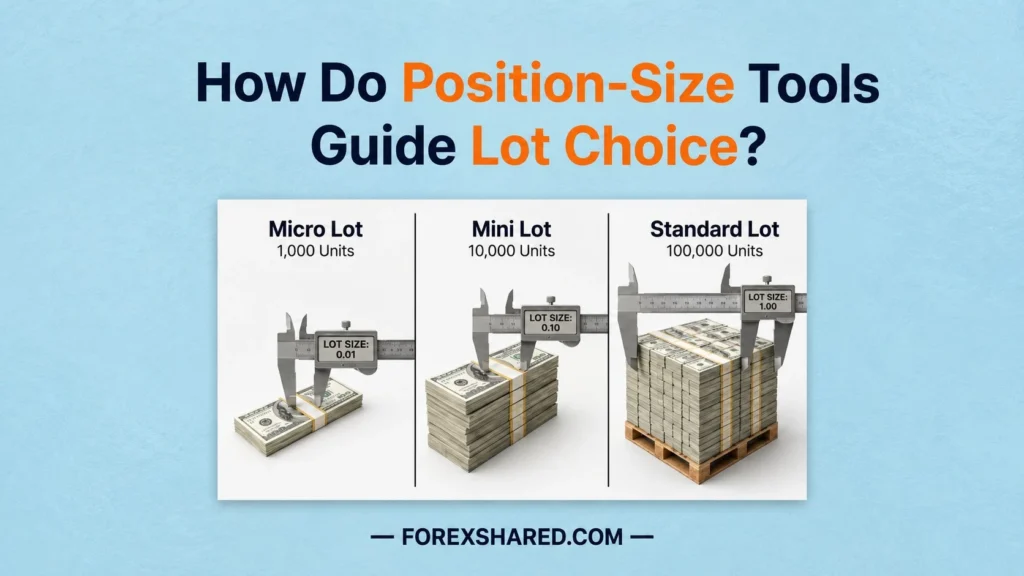
Before entering the number on the platform, the trader should confirm whether the platform display relies on lots, decimal lots, or raw units. Misunderstanding the data entry formatting translates a perfectly calculated 0.10 mini lot into an accidental micro or standard disaster.
When should the trader choose smaller than the tool suggests?
Choosing smaller than the tool suggests may make sense when the output feels too aggressive for normal movement or current conditions. Modifying the metric downward preserves critical emotional stability without violating the original upper risk constraints.
A suggested lot size should be interpreted as structured guidance, not as automatic permission to trade.
What mistakes make position-size tools give poor lot guidance?
Position-size tools give poor lot guidance when the inputs are unrealistic or the output is treated as automatic permission. Identifying and isolating these failure modes drastically enhances strategic precision.
Entering a stop distance that does not match the real trade plan
Mistake: The trader uses a convenient stop distance instead of the distance that matches the trade idea.
Correction: The stop input should accurately reflect where the technical trade idea is genuinely invalidated on the chart.
Choosing risk input from emotion instead of plan
Mistake: The trader artificially increases risk thresholds simply because the setup visually feels strong.
Correction: The risk input must stay brutally consistent with the mathematical plan, ignoring situational conviction.
Ignoring platform lot-display differences
Mistake: The trader blindly accepts the calculated output but incorrectly enters the wrong order size on the interface.
Correction: The trader must definitively confirm how their specific platform displays lots or raw base units.
Treating the suggested lot as guaranteed safety
Mistake: The trader dangerously assumes the sizing tool removes all directional market risk.
Correction: The tool effectively supports sizing dimensions; it absolutely does not control ambient market behavior.
Position-size tools give poor guidance when inputs are unrealistic or the output is treated as automatic permission.
How can traders fix a lot choice that feels too large after using a tool?
A lot choice that feels too large should be fixed by reviewing the inputs and reducing position size rather than forcing the trade to fit the output. Recognizing unease immediately signals that the calculated parameters breach internal stress limits.
What should be adjusted when pip movement feels uncomfortable?
When pip movement feels uncomfortable, lot size is usually the cleanest variable to reduce. Contracting the executed size instantly suffocates excessive pip impact and rapidly restores psychological control.
Which input should be reviewed when the suggested size looks unrealistic?
When the suggested size looks unrealistic, the trader should review risk input, stop distance, pair selection, and account currency. Catching a typographic error inside the input fields predictably resolves absurd geometric outputs.
Where does overconfidence hide in tool use?
Overconfidence can hide in tool use when the trader raises the risk input or ignores discomfort with the suggested output. Manipulating variables strictly to permit heavier volume nullifies the tool's entire defensive purpose.
If the suggested lot size feels too large, the trader should reduce size and review the inputs instead of forcing the trade.
What should traders validate before accepting a position-size tool output?
Before accepting a position-size tool output, traders should confirm that the inputs, output format, and practical transaction risk context all match the real plan. Activating this sequence effectively neutralizes entry hazards (National Futures Association).
The biggest mistake is treating a position-size tool as a decision-maker. A better approach is to treat it as a sizing guide that helps the trader connect risk, stop distance, pip movement, notional exposure, and lot choice more clearly.
Position-Size Tool FAQs
Do position-size tools guarantee I won't blow my account?
No. These tools provide mathematical guidance based on your inputs. If your stop loss suffers massive slippage during a news event, or if you refuse to close a losing trade, your account can still suffer extreme damage regardless of the initial calculation.
Why does the tool give me a different lot size for different pairs with the same stop distance?
Because the pip value fluctuates depending on the currency pair's quote currency relative to your account currency. The tool automatically adjusts the lot size to ensure your fixed cash risk remains accurate across differing exchange rates.
Can I just use my margin percentage to size my trade instead?
No. Relying on margin capacity is extremely dangerous. Margin merely reflects broker collateral requirements, not your actual market exposure. Position-size tools focus on how much you will lose if the trade fails, which is the only reliable way to manage risk.