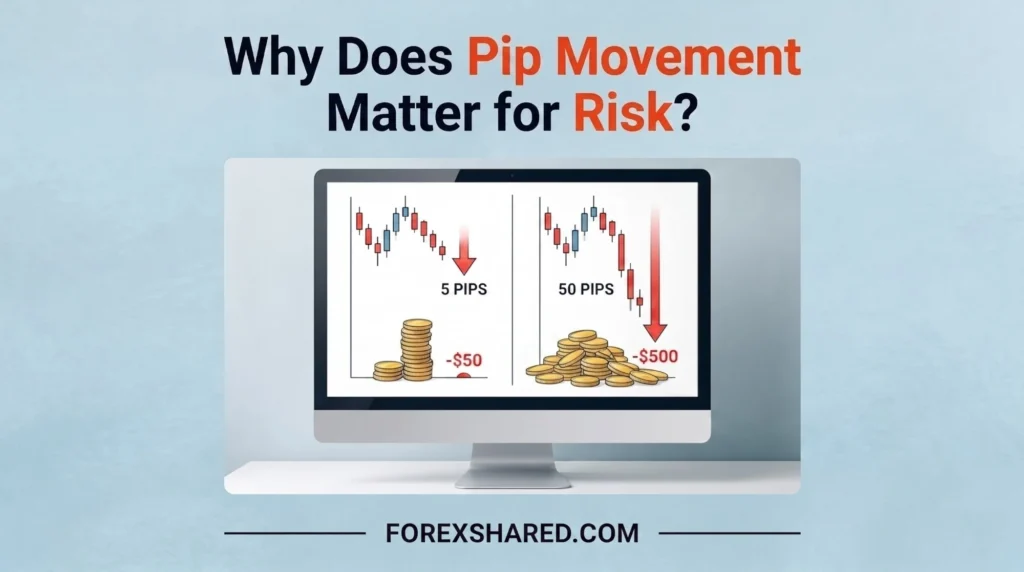
Why Does Pip Movement Matter for Risk?
Pip Movement matters for risk because it measures how far price can move against a position before that distance becomes money loss. Many readers know a pip is a small move in forex, but that description is too weak. In reality, pip movement provides the foundational distance layer, creating an absolute spatial boundary for your capital's survival.
Pip movement executes four connected jobs: measuring adverse price distance, defining stop-loss distance, scaling potential loss through pip value and trade size, and giving traders a common way to compare planned risk across setups. Pip movement is fundamentally the distance layer of risk, while cash loss appears only later through pip value, position size, spread, and execution handling.
warning EDUCATIONAL DISCLAIMER
This page is educational only. It is not trading advice, not a signal page, not a broker recommendation, and not execution coaching. The article must explain risk mechanics, not promise profit protection.
Why Do So Many Readers Misunderstand Why Pip Movement Matters for Risk?
Many readers misunderstand why Pip Movement matters for risk because they hear pips first in profit language and only later as adverse-distance language. If risk distances are ignored during the learning phase, the resulting financial damage is sudden and extreme.
Why Does Pip Movement Sound Like a Profit Topic Instead of a Risk Topic?
Pip movement sounds like a profit topic instead of a risk topic because beginners often first hear pips in gain-and-loss conversations. When a single standardized movement unit is continually highlighted strictly to describe massive wins, the structural risk-distance role is inevitably missed (OANDA, n.d.)(IG, n.d.).
Why Do Beginners Confuse Pip Movement with Money Risk?
Beginners confuse pip movement with money risk because they mix distance measurement with cash translation. Since distance is enthusiastically measured first but the money meaning must carefully be added later, the two distinct layers frequently get disastrously confused (IG, n.d.)(OANDA, n.d.).
Why Does This Misread Create Bigger Problems Later?
This misread creates bigger problems later because it distorts stop placement, trade-size reading, and the meaning of pip value. Risk begins as adverse pip distance before it becomes cash damage. Because the pip movement is erroneously mistaken for fixed cash upfront, the critical stop and size logic heavily breaks down later (OANDA, n.d.)(IG, n.d.).
| What the Reader Assumes | What Pip Movement Actually Tells You About Risk | Why It Matters |
|---|---|---|
| A pip move is an automatic dollar loss. | It measures the dimensional distance the market traveled against you. | Fusing distance with cash blindly guarantees massive overleveraging. |
| 30 Pips risk means exactly $30. | It dictates that the quote can shift 30 standardized steps before invalidation. | Pip value dynamics adjust constantly based on active lot constraints. |
What Is Pip Movement, and Why Does It Matter for Risk at All?
Pip Movement (quote distance measured in pip units) is the quote distance a currency pair has moved, and it matters for risk because every adverse move begins there. Connecting to Pip size and quote interpretation ensures the foundational distance logic remains rigorously solid.
What Is Pip Movement in Plain English?
In plain English, Pip Movement is the number of pips price has moved from one quote level to another. If the quote visibly changes, pips successfully count the change, ensuring movement reliably becomes comparable (OANDA, n.d.).
What Is Pip Movement Not?
Pip movement is not automatically a dollar amount, not the same thing as pip value (money attached to one pip of movement after size and pair inputs are added), and not the same thing as realized account loss. Once pip distance is bounded correctly, money and outcome layers abruptly stop being mixed (IG, n.d.)(OANDA, n.d.).
Why Does Risk Need a Standard Distance Unit?
Risk needs a standard distance unit because adverse movement cannot be managed consistently without one common measure. Since risk must definitively be measured, pips elegantly standardize the distance, meaning stops completely become readable (OANDA, n.d.)(IG, n.d.).
| Pair Type | Pip Convention | What Pip Movement Measures | Why That Matters for Risk |
|---|---|---|---|
| Non-JPY (EUR/USD) | 4th Decimal | The precise structural step count away from entry. | Quantifies exactly how far the trade deviates from equilibrium. |
| JPY Cross (USD/JPY) | 2nd Decimal | The exact standardized distance via Yen parameters. | Unifies Japanese Yen volatility into a common defensive scale. |
How Does Adverse Pip Movement Create Risk?
Adverse Pip Movement creates risk because price movement against the position is what threatens the trade. An adverse pip move (price movement in pips against the position) physically erodes the structural safety margin of the setup.
Why Does Pip Movement Against the Trade Represent Risk?
Pip movement against the trade represents risk because each adverse pip increases the distance between the trade and safety. As price stubbornly moves against the position, adverse pip distance ominously grows, ensuring trade risk deeply deepens (OANDA, n.d.)(IG, n.d.).
Why Is Risk Better Understood as Distance First and Money Second?
Risk is better understood as distance first and money second because price must move before that movement can be translated into cash loss. When distance is measured, pip value is rigorously applied later, meaning cash risk safely appears afterward (IG, n.d.).
Why Is Pip Movement the First Layer of Trade Risk?
Pip movement is the first layer of trade risk because the market hurts the position in distance terms before it hurts it in money terms. The market hurts you in pips before it hurts you in cash. Because the quote aggressively moves first, risk exists in pips first, meaning the money effect inevitably follows (OANDA, n.d.)(IG, n.d.).
| Position Type | Adverse Market Move | Pip Distance Against Trade | Risk Meaning |
|---|---|---|---|
| Long (1.1050) | Drops to 1.1020 | -30 Pips | The asset collapsed 30 structural steps against the assumed trajectory. |
| Short (150.00) | Rallies to 150.40 | -40 Pips | The asset expanded 40 pips upwards, squeezing the entry basis. |
How Does Stop-Loss Distance in Pips Turn Pip Movement into Planned Risk?
Stop-loss distance in pips (number of pips between entry and stop) turns Pip Movement into planned risk because it defines how much adverse distance the trade is allowed to absorb. Planned pip risk (stop-defined adverse distance the trade is allowed to absorb) creates an unbreakable perimeter around chaotic charts.
Why Is Stop Distance Usually Measured in Pips?
Stop distance is usually measured in pips because stop placement is a quote-distance problem before it is a money problem. If the entry is definitively defined and the stop is rigorously set in pip distance, planned risk securely becomes measurable (IG, n.d.)(OANDA, n.d.).
How Does Pip Distance Define Maximum Planned Adverse Movement?
Pip distance defines maximum planned adverse movement by drawing a hard boundary between entry and stop in pip terms. Because the stop is firmly placed, maximum pip damage is capped, meaning planned risk decisively becomes visible (IG, n.d.)(OANDA, n.d.).
Why Does This Make Pip Movement Central to Risk Planning?
This makes pip movement central to risk planning because the stop is really a limit on allowed adverse pip travel. Your stop is really your maximum allowed pip damage. As the stop plan is carefully built and pip distance defines it, the risk plan immediately gains profound structure (IG, n.d.).
| Entry | Stop | Adverse Quote Difference | Planned Risk in Pips |
|---|---|---|---|
| 1.1050 (Buy) | 1.1030 | 0.0020 Drawdown Limit | 20 Pips Risk Envelope |
| 150.00 (Sell) | 150.50 | 0.50 Drawdown Limit | 50 Pips Risk Envelope |
How Does Pip Value Turn Planned Risk Distance into Money Risk?
Pip Value turns planned risk distance into money risk by attaching cash meaning to each pip of adverse movement. Reading Pip value and risk size protects portfolios from overestimating their financial buffers.
Why Does Pip Movement Measure Distance While Pip Value Measures Money?
Pip movement measures distance while pip value measures money because the two belong to different layers of the same risk chain. When pip distance is confidently known and pip value flawlessly translates it, cash risk thoroughly becomes readable (IG, n.d.).
Why Does the Same Adverse Pip Move Not Cost the Same on Every Trade?
The same adverse pip move does not cost the same on every trade because pair, size, and exchange rate change the money translation. If the same pip distance vigorously exists but inputs wildly differ, cash risk radically changes (IG, n.d.).
Why Is This Distinction Essential for Correct Risk Reading?
This distinction is essential for correct risk reading because the reader must know whether they are measuring distance or pricing that distance. Pips tell you how far risk can travel; pip value tells you how expensive that travel is. Because movement is measured first and money is meticulously added second, categories definitively stay clean (IG, n.d.).
| Concept | What It Measures | What Changes It | What It Should Not Be Confused With |
|---|---|---|---|
| Pip Movement | The geographical quote distance. | Nothing; 20 pips is precisely 20 pips. | The amount of money gained or lost. |
| Pip Value | The financial density of the move. | Lot sizing and Quote currency strength. | The physical distance displayed on the chart. |
How Does Trade Size Change the Risk Meaning of the Same Pip Movement?
Trade size changes the risk meaning of the same Pip Movement because the same adverse distance becomes more or less expensive as position size changes. Utilizing Position-size tools for lot choice safely governs this expansion.
Why Is One Adverse Pip More Dangerous on a Bigger Position?
One adverse pip is more dangerous on a bigger position because more units are exposed to the same move. As position size rapidly grows and one-pip value steadily grows, the same adverse move painfully hurts more (IG, n.d.)(OANDA, n.d.).
Why Does the Same Pip Movement Feel Smaller on a Smaller Trade?
The same pip movement feels smaller on a smaller trade because fewer units are exposed to the move. If size predictably shrinks and one-pip value heavily shrinks, the same distance ultimately costs less (IG, n.d.)(OANDA, n.d.).
Why Does This Make Position Size Central to Pip-Based Risk?
This makes position size central to pip-based risk because size decides how painful the same adverse distance becomes. The market may move the same distance, but size decides how painful that distance is. While distance decisively stays fixed and size actively changes, money risk unequivocally changes anyway (IG, n.d.)(OANDA, n.d.).
| Trade Size | One-Pip Value Logic | Same Adverse Move | Why Risk Changes |
|---|---|---|---|
| 0.01 Micro Lot | Roughly $0.10 | 20 Pips | Small volume mutes P&L to roughly a $2.00 threat. |
| 1.00 Standard Lot | Roughly $10.00 | 20 Pips | Massive volume amplifies P&L to a severe $200.00 liability. |
How Do Pair Convention and Exchange Rate Change the Risk Meaning of Pip Movement?
Pair convention and exchange rate change the risk meaning of Pip Movement because the movement unit stays standardized while the money translation changes. Blindly assuming 20 pips across random pairs yields uniform risk guarantees account ruin.
Why Do JPY Pairs Change the Way Pip Movement Is Read?
JPY pairs change the way pip movement is read because many yen quotes use a different visible pip convention. Because pair type significantly changes and the visible pip rule changes, risk reading logically must adjust (OANDA, n.d.).
Why Does the Exchange Rate Change the Cash Meaning of the Same Pip Distance?
The exchange rate changes the cash meaning of the same pip distance because pip value depends on more than movement alone. When pip distance is entirely fixed but the translation rate violently changes, cash risk inherently changes (IG, n.d.).
Why Does This Make Pip-Based Risk a Pair-Structure Problem Too?
This makes pip-based risk a pair-structure problem too because the pip stays standard while the risk cost shifts with the pair. The pip stays standard, but the risk cost shifts with the pair. If movement language impeccably stays stable and pair structure wildly changes translation, risk meaning unmistakably changes (OANDA, n.d.)(IG, n.d.).
| Pair | Pip Convention | Pip Value Logic | Why Risk Meaning Changes |
|---|---|---|---|
| EUR/USD | 4th Decimal | USD dominated (usually $10 per standard lot). | Yields stable USD-denominated risk trajectories. |
| EUR/GBP | 4th Decimal | GBP dominated (approx. £10 per lot). | Requires an active exchange rate conversion to display final USD risk outcome. |
How Does Spread Turn Planned Pip Risk into Effective Risk Before the Market Even Moves?
Spread (bid/ask cost distance that affects effective risk) turns planned pip risk into effective pip risk (practical risk after spread and execution friction are considered) before the market even moves because execution starts with a bid/ask disadvantage. A 20-pip stop is an illusion if the spread steals 3 pips instantly upon entry.
Why Does Spread Matter for Risk Before the Trade Moves?
Spread matters for risk before the trade moves because part of the usable distance is already consumed by transaction cost. As the trade cleanly opens and spread is relentlessly paid, the effective adverse cushion shrinks immediately (OANDA, n.d.)(IG, n.d.).
Why Is Planned Pip Risk Not the Same as Effective Risk?
Planned pip risk is not the same as effective risk because clean stop distance and live trade reality are separated by spread and execution conditions. When the stop is thoughtfully defined cleanly and spread destructively intervenes first, effective risk sharply differs (OANDA, n.d.).
Why Does This Mean Clean Pip Distance Is Not the Whole Story?
This means clean pip distance is not the whole story because some risk is already active before fresh adverse movement arrives. Before the market moves against you, spread already claims some distance. Because spread rapidly consumes distance first, planned pip risk painfully becomes effective risk sooner (OANDA, n.d.).
| Planned Stop Distance | Spread Cost | Effective Risk Logic | Why It Matters |
|---|---|---|---|
| 30 Pips | 3 Pips | The trade absorbs a 3-pip deficit instantly, leaving only 27 pips of free movement. | Stops will trigger slightly before the physical chart reaches the analytical line. |
| 10 Pips (Tight) | 2 Pips | A massive 20% of the risk envelope is annihilated before volatility even begins. | Exposes ultra-tight scalping strategies as mathematically fragile. |
How Do Entry Price, Stop Price, and Pip Distance Work Together in Risk?
Entry price, stop price, and pip distance work together in risk because planned exposure begins as the gap between entry and stop. Constructing this spatial boundary is mandatory before execution algorithms launch.
Why Is Risk in Pips Really an Entry-to-Stop Distance Calculation?
Risk in pips is really an entry-to-stop distance calculation because adverse exposure is measured by how far price can move before exit. If entry is definitively set and the stop is smartly set, the pip distance brilliantly between them solidly defines planned risk (IG, n.d.)(OANDA, n.d.).
How Does the Stop Price Define Maximum Planned Pip Loss?
The stop price defines maximum planned pip loss by marking the adverse quote level where the trade is designed to exit. Because the stop is securely fixed, max pip loss is powerfully bounded, meaning risk efficiently becomes manageable (OANDA, n.d.)(IG, n.d.).
Why Does This Make Pip Movement the Skeleton of Risk Planning?
This makes pip movement the skeleton of risk planning because the stop structure is really a pip-distance structure underneath. Planned risk is really planned pip distance. As the stop plan is intelligently built and pip distance structurally defines it, the risk plan effortlessly gains structure (OANDA, n.d.)(IG, n.d.).
| Entry | Stop | Quote Difference | Pip Risk | Why It Matters |
|---|---|---|---|---|
| 1.1050 (Buy) | 1.1020 | 0.0030 | 30 Pips | Provides the unshakeable foundation for lot-size formulation. |
| 150.00 (Sell) | 150.50 | 0.50 | 50 Pips | Ensures JPY crosses utilize the exact same distance mathematics. |
How Do Pip-Based Risk and Realized Cash Loss Differ?
Pip-based risk and realized cash loss differ because distance measurement, cash sensitivity, and final execution outcome are separate layers. Believing a 20-pip stop guarantees a $200 limit assumes frictionless markets.
Why Does a 20-Pip Risk Not Automatically Mean One Exact Cash Loss?
A 20-pip risk does not automatically mean one exact cash loss because pip distance still needs size, pair, spread, and execution to become a final number. When pip distance is decisively known but translation inputs dangerously vary, the exact cash result is essentially not fixed yet (IG, n.d.).
Why Can Currency Conversion Matter for Final Loss?
Currency conversion can matter for final loss because the trade’s movement layer and the account’s money layer are not always in the same currency. As pip loss is accurately measured and value is eventually translated into account currency, final loss meaning can heavily change (OANDA, n.d.)(IG, n.d.).
Why Is Realized Risk One Layer Beyond Pip Distance?
Realized risk is one layer beyond pip distance because final money loss appears only after spread, slippage, execution, and conversion are applied. Pip risk is the movement threat; realized loss is the money result after all layers are applied. Since distance is thoroughly measured and pricing is seamlessly translated, execution and conversion finally finalize the result (OANDA, n.d.)(IG, n.d.).
| Layer | What It Represents | What Else Is Needed | Common Misread |
|---|---|---|---|
| Pip Risk | Dimensional space captured. | Volume Scaling. | Assuming pips equal flat dollars directly. |
| Realized Cash Loss | Cleared accounting liquidity. | Final cross-border fiat conversion. | Ignoring fluctuating EUR/USD cross rates on GBP accounts. |
How Does Pip Movement Help Compare Risk Across Trades Before Money Is Added?
Pip Movement helps compare risk across trades before money is added because it gives traders one common distance language. Standardizing threat evaluation allows systems to assess vulnerability rapidly.
Why Is Pip Distance Useful for Comparing Setups?
Pip distance is useful for comparing setups because it lets traders compare adverse movement allowance before they price that allowance in cash. Because setups wildly differ and pip distance cleanly standardizes the comparison, risk effectively becomes comparable earlier (OANDA, n.d.)(IG, n.d.).
Why Is Cash Risk Still Needed After Pip Comparison?
Cash risk is still needed after pip comparison because equal distance does not guarantee equal money exposure. When pip comparison is competently done and size and pair are added, money comparison brilliantly becomes more precise (IG, n.d.).
Why Does This Make Pip Movement a Common Risk Language?
This makes pip movement a common risk language because traders can compare danger before they fully price that danger. Pips let traders compare danger before they price the danger. As pips standardize adverse distance, comparison becomes infinitely cleaner, and later cash translation predictably becomes easier (OANDA, n.d.)(IG, n.d.).
| Trade Setup | Stop Distance in Pips | What It Tells You | What It Still Doesn’t Finish |
|---|---|---|---|
| Setup A (EUR/USD) | 20 Pips | Tight invalidation parameter. | Does not clarify whether 20 pips costs $20 or $2,000. |
| Setup B (GBP/JPY) | 50 Pips | Wider, looser volatility allowance. | Requires size scaling to match Setup A's total capital liability. |
How Do Spot FX and Standardized FX Products Show the Same Risk Logic Differently?
Spot FX and standardized FX products show the same broader risk logic differently because spot speaks in pips while standardized products often publish tick value directly. Overlapping these distinct vocabularies causes terminal confusion.
How Does Spot FX Use Pips to Read Risk?
In spot FX, pips are the familiar language for adverse distance, stop placement, and risk comparison. When the spot quote aggressively moves and pips smoothly measure the move, risk is perfectly described through pip language (OANDA, n.d.)(IG, n.d.).
How Do Standardized Products Make the Money Layer More Explicit Through Tick Value?
Standardized products make the money layer more explicit through published tick value because the exchange directly states what a minimum move is worth per contract. Because the exchange perfectly defines the movement unit and the contract fiercely publishes the value, the money layer is profoundly made more explicit (CME Group, 2026).
Why Should Readers Compare the Two Without Treating Them as Identical?
Readers should compare the two without treating them as identical because the same risk sequence exists, but the market language and packaging differ. Spot speaks in pips; standardized products often publish tick value directly. Because the risk sequence is similar but the product language notably differs, the reader must vigilantly keep structures distinct (OANDA, n.d.)(CME Group, 2026).
| Context | Movement Unit | Money Layer | What Can Look Different |
|---|---|---|---|
| OTC Spot FX | Pip | Dynamically generated via Lot Sizing. | Complete freedom to mold fractional risk. |
| CME Futures | Tick | Static exchange-published ($6.25 per tick). | Rigid block requirements enforce fixed monetary jumps. |
How Do Pip Movement, Stop Distance, Pip Value, and Execution Fit Together as One Risk System?
Pip Movement, stop distance, pip value, and execution fit together as one risk system because each layer builds on the previous one without replacing it. Segmenting these variables destroys unified portfolio management.
How Does Pip Movement Anchor Risk Distance?
Pip movement anchors risk distance by measuring the adverse move in one standardized unit. When quote changes aggressively occur and adverse pips are accurately counted, risk distance robustly becomes clear (OANDA, n.d.)(IG, n.d.).
How Does Stop Distance Turn That Movement into Planned Risk?
Stop distance turns that movement into planned risk by capping how many adverse pips the trade is allowed to absorb. Since the stop is deliberately set and max adverse pip travel is firmly defined, planned risk wonderfully appears (IG, n.d.)(OANDA, n.d.).
How Does Pip Value Turn That Risk into Money?
Pip value turns that risk into money by pricing each pip of adverse movement under the trade’s specific conditions. When pip risk is deeply known and pip value is intelligently applied, cash risk absolutely becomes interpretable (IG, n.d.).
How Do Spread, Pair Structure, and Execution Context Change the Final Outcome Without Replacing the Structure?
Spread, pair structure, and execution context change the final outcome without replacing the structure because they alter how pip risk is experienced, not whether pip risk exists. As the core pip-risk framework is successfully set and context dynamically modifies cash outcome, structure magnificently remains intact (OANDA, n.d.)(IG, n.d.).
| Risk Layer | What It Defines | What Changes by Context | What Stays Structurally True | Main Misread |
|---|---|---|---|---|
| pip movement | Dimensional shift | Volatility scaling | Base distance unit | Equating it to dollars directly |
| adverse distance | Negative trajectory | Trend invalidation levels | Vector of capital decay | Ignoring inversion math |
| planned stop distance | The theoretical cap | Chart structure logic | The mechanical trigger perimeter | Assuming stops kill 100% of risk |
| effective risk after spread | Execution friction toll | Liquidity gaps | Negative entry basis | Treating spread as negligible |
| pip value | Monetary weight per tick | Base/Quote currency | Translation mechanics | Assuming standard lot means standard profit |
| trade size | Volume deployed | Leverage ratio | Scaling modifier | Assuming small size is immune to liquidation |
| pair / exchange-rate effect | Cross parity output | Macro news events | Mathematical denominator rule | Applying 4-decimal logic to JPY |
| execution / slippage | The true cost of market exit | News events and volume vacuums | The mechanical degradation of price | Believing stops eliminate all exit risk |
| realized cash loss | Bankable equity damage | Slippage and swaps | Terminal resolution | Assuming floating paper loss isn't real |
What Do Readers Commonly Misread About Why Pip Movement Matters for Risk?
Readers commonly misread why Pip Movement matters for risk when they reduce it to profit language or assume distance already equals money. Erasing these myths protects capital from lazy accounting errors.
“Pips Matter Only for Profit” — When Risk Distance Is Ignored
The statement ‘pips matter only for profit’ ignores that pips also measure adverse movement against the trade. If pip language is recklessly narrowed to profit, the risk-distance role abruptly disappears (OANDA, n.d.)(IG, n.d.).
“A 20-Pip Stop Means the Same Risk on Every Trade” — When Pip Value and Size Are Ignored
The statement ‘a 20-pip stop means the same risk on every trade’ ignores that distance and cash risk are not the same thing. Because stop distance is held rigidly constant but size or pair dramatically changes, cash risk dangerously still changes (IG, n.d.).
“Spread Doesn’t Matter If I Know My Stop” — When Planned and Effective Risk Are Mixed
The statement ‘spread doesn’t matter if I know my stop’ mixes clean stop distance with the effective risk of a live trade. When the stop is confidently known but the spread is blindly ignored, effective risk is perilously understated (OANDA, n.d.).
“If I Know the Pips, I Know the Exact Loss” — When Execution and Conversion Are Ignored
The statement ‘if I know the pips, I know the exact loss’ ignores execution, spread, and currency-conversion layers. Since pip distance is loosely known but later modifiers are completely skipped, exact loss is terribly and wrongly assumed (OANDA, n.d.)(IG, n.d.).
| Common Reader Statement | What It Misses | Correct Interpretation |
|---|---|---|
| "The pair moved 50 pips, I should be broke." | It misses that volume dictates the value extraction of those 50 pips. | "The pair moved 50 pips; my sizing dictates the financial yield." |
| "My stop was 20 pips, so I only risk $20." | It confuses linear distance with dynamic lot multipliers. | "My stop is 20 pips; I must check my pip value to price it." |
How Do You Read Why Pip Movement Matters for Risk Correctly from Start to Finish?
Pip Movement is read correctly for risk only when the reader moves step by step from adverse distance to stop layer, value layer, execution layer, and final money layer. Sequential processing enforces trading safety.
Step 1 — Identify the Adverse Pip Distance
The first step is to identify how far price can move against the position in pip terms. Because quote movement is actively observed and adverse distance is fiercely measured, risk reading properly begins (OANDA, n.d.)(IG, n.d.).
Step 2 — Identify the Stop-Loss Layer
The second step is to identify where the stop sits in pips from entry. Once the stop is intelligently located, max planned adverse movement is precisely defined (IG, n.d.)(OANDA, n.d.).
Step 3 — Identify the Pip Value Layer
The third step is to identify what one pip is worth on this specific trade. As pip risk is securely known and one-pip value is smartly attached, money sensitivity exceptionally becomes readable (IG, n.d.).
Step 4 — Identify Spread and Execution Effects
The fourth step is to identify what changes the clean pip-distance risk in live execution. If clean stop distance boldly exists but live trade conditions harshly intervene, effective risk inevitably changes (OANDA, n.d.).
Step 5 — Identify the Final Money Outcome
The fifth step is to identify whether the final result is being read in quote currency or account currency. When pip risk is reliably priced and conversion context is flawlessly checked, final money outcome is interpreted far more safely (OANDA, n.d.)(IG, n.d.).
| Question | Why It Matters | Common Mistake If Skipped |
|---|---|---|
| What is the Pip Value of your chosen Lot Size? | Converts chart distance into capital velocity. | Opening a position completely blind to the account-ruining scaling effect. |
| Is this the Planned or Effective risk? | Ensures the bid/ask toll is fully paid before counting stops. | Assuming a 10 pip stop guarantees survival when spreads widen to 8 pips. |
Final Checklist — Are You Interpreting Why Pip Movement Matters for Risk the Right Way?
Pip Movement is being interpreted correctly for risk only when the reader validates the distance role, stop-loss role, money layer, and realized-outcome layer together.
Validate the Distance Role
Validating the distance role means confirming that you know pip movement measures how far price can move against the trade. When the movement role is heavily validated, cash confusion is broadly reduced (OANDA, n.d.)(IG, n.d.).
- Do you know that pip movement measures how far price can move against the trade?
Validate the Stop-Loss Role
Validating the stop-loss role means confirming that you know why stop distance in pips is a core risk input. By confirming the direction role is consistently validated, favorable and unfavorable movement instantly stop being confused (OANDA, n.d.).
- Do you know why stop distance in pips is a core risk input?
Validate the Money Layer
Validating the money layer means confirming that you know how pip value and trade size turn pip distance into cash risk. If the money layer is reliably validated, pip and pip value structurally stop being mixed (IG, n.d.).
- Do you know how pip value and trade size turn pip distance into cash risk?
Validate the Realized Outcome Layer
Validating the realized-outcome layer means separating planned pip risk from effective risk and from realized cash loss after spread, execution, and currency conversion. Because the net layer is securely validated, clean movement is no longer mistakenly taken for final cash outcome (OANDA, n.d.)(IG, n.d.).
- Are you separating planned pip risk from effective risk and from realized cash loss after spread, execution, and currency conversion?
Final Reader Takeaway
Pip movement matters for risk because it measures the distance price can move against a position. Pip Movement matters for risk because it measures the distance price can move against a position, and that distance is what traders cap with stops and later translate into money loss through pip value and trade size. The cash meaning of that risk appears only after spread, pair structure, execution, and account-currency conversion are added.
Pip Risk FAQs
What is Pip Movement in plain English?
In plain English, Pip Movement is the number of pips price has moved from one quote level to another.
Why is Pip Movement not the same as Realized Cash Loss?
Pip movement is the quote distance a currency pair has moved, but it only becomes a realized cash loss after trade size, pip value, spread, execution friction, and account currency conversion are calculated.
Why is stop distance usually measured in pips?
Stop distance is usually measured in pips because stop placement is a quote-distance problem before it is a money problem. It helps traders define the exact adverse movement a position can safely absorb.